
Sinners was not a movie I planned on watching. I remember seeing the trailer quite often (I have AMC A-List) and feeling a bit cringed it. It had all of the hallmarks of a vampire flick: not letting the baddies in, “that’s not your brother anymore” (spoiling a bit of the plot it seems), and snippets of a dramatic final battle.The fact that it was more of an action flick than a horror did intrigue me slightly, but I wasn’t sold; maybe I’d watch it on a random night once it was available to stream. The shot of Michael B. Jordan banging his head against the door to the beat of the trailer music also didn’t help.
However, once the press embargo was lifted and reviews started pouring it, it was clear that this movie was good. I don’t really trust most review sites (let alone Rotten Tomatoes) but it looked like people were in consensus: Ryan Coogler had done it again. I decided to swallow my fear (any kind of horror makes my anxious self very queasy) and watch it by myself (as I normally do). And boy was I blown away.
I blame the trailers for setting it up poorly. While Sinners does indeed contain a vampire plot in a Southern Gothic setting, it’s ultimately a much deeper film. Through its various characters, both human and vampire, Coogler gives us a story that touches on so many themes. Disenfranchisement, post-slavery racism, gangster drama, ill-fated romance, and the power of music are all contained in a powerhouse of a film that still contains human vs. vampire battle.
Despite the plethora of subjects, the film is quite simple and straightforward. Smoke and Stack, twin ex-gangsters/WWI vets (played by Michael B. Jordan), have returned to their hometown in Mississippi to go straight and set up a juke joint. Over the course of a day, they recruit their nephew Preacher Boy Sammy and musician elder Delta Slim to play the music at their establishment; they also run into old loves and friends who help them set up. The threat of the KKK as well as the gangs that the Twins have ripped off loom over it, but the vibe of the party is still quite optimistic. That is until three white folk (vampires) show up at the jukejoint’s front door, looking for an invitation to come inside.
For me, the biggest part of the film is the immersion. With its high concepts and nuanced dives into different film genres and tropes, Sinners had the potential to be bad. I will admit that it can be a bit clunky, but I still found the symbolism and messaging easy to follow. A lot of this is because the film is incredibly grounded and realistic. It really is about a group of people trying to have a good time and escape the Depression, as well as the racist factors of disenfranchisement and violent bigots. It certainly makes the vampires come out of left field, in the best way possible. In other words, it makes for such a compelling and fresh film.

For me, a big part of this immersion and grounded quality is due to the excellent costuming. Everyone in the movie looks like they’re right out of an early 30s photograph, but not in the typical way. This isn’t a glamorous movie about socalites. This is about working class, disenfranchised people in the Missispi Delta who are making the most out of their lives during one fateful night. Ruth E. Carter says in Harpers Bazaar that her team studied photos of Black families in the Mississippi Delta during the 1920s and 30s. They wanted Sinners to feel real and undoubtedly American, and I think they succeeded.
For the menswear, this meant a mix of tailoring and workwear. None of it is “nice”, as each garment is a bit too big or small, stained, and patched because it’s what they have. Clothes are lived in and made to work. Workshirts are paired with suits. Dress shoes are worn with work pants. Striped dress shirts are worn sans collar and put under overalls. Fedoras and other brimmed hats aren’t worn because it’s “proper” but because you need shade from the sun; as a result, headwear is faded with ribbons stained through or missing completely. With the makeshift aesthetic, each character and extra has a distinct look all while looking incredibly authentic and real. Everyone looks like they could have been snapped by Eudora Welty (mentioned directly by Carter), Walker Evans, and other Depression-era photographers, which is a testament to the realism of the film…and makes the fantastical dark turn all the more enthralling..
I particularly like the outfits worn by Preacher Boy Sammie and Delta Slim, our male musician characters (hell Sammie is basically the main character), Their attire serves as great examples of Carter’s detailed vintage and character-based styling. Sammie has on a 10s/20s workshirt, fastened to the top because he lacks a tie. He seems to have cobbled the best sartorial fit he could muster for the Juke Joint (though he wears it all day), wearing a chore-blazer over a waistcoat, both made of cotton and patched to hell. Delta Slim has a similar approach, as he also wears a checked workshirt (his plaid is bigger) underneath a waistcoat and sportcoat. Slim is a bit older and functions as a bit of a grandfather-mentor to Sammie and comes off a bit dandier, thanks to the use of a derby hat and watch chain across his waistcoat. What’s interesting is that both of them wear spectator (two-tone) shoes, which to me serves as a nod to their mutual connection to music and perhaps a bit of showmanship. I bet you there were plenty of musicians in the South during that time that dressed just like Sammie and Slim.
Of course, there’s two other characters with an even bolder sense of dress that certainly take the cake: Smoke and Stack.


These two ex-gangster brothers are hard not to notice. Granted, they aren’t the only ones in hats and jackets, but the twins are on another level. They’re fancier and sophisticated… by which I mean they have immaculate suits, money, guns, and life experience after serving in WWI and two-timing the Italian and Irish Gangs in Chicago. It just makes sense for the twins to look a little out of place when they suddenly appear back home and try to “go straight” with a juke joint (that was doomed to fail). But good film costuming is about more than just giving nice suits to some characters and workwear to others. When you look closer, you’ll find all the fun nuance that Ruth E. Carter did in dressing Smoke and Stack. And I’m not just talking about the color coordination in the hats and shirts.
Smoke has one of the best vintage-style suits I’ve seen in a film, and that’s simply because of all the details. His 3PC suit is a grey-blue (ish) houndstooth and features quad-pleated and flapped patch pockets, making his approach much more casual than a typical business suit. These types of “sport suits” (which usually feature a belt back) were common in the 1920s and 1930s (especially in Europe), with some variations opting for plus-fours (instead of normal trousers) to play into the sporty look. This makes Smoke come across as rugged and utilitarian, which plays into his pragmatic and skeptical personality. His suit is also meant to be a little loose in order to hide his dual pistols.
This casual vibe continues with his shirt, which features a blue base and a stiff and detachable cutaway collar shirt. This type of shirt would certainly be considered formal (especially compared to soft, attached collar shirts), but forgoing the tie does make a big deal in making things decidedly dressed down and more workwear. The denim flat cap, which provides the most striking use of blue in the outfit, emphasizes the casual, “everyman” vibe. In a meta sense, these details call Peaky Blinders to mind, which seems intentional when we consider the fact that the brothers did work for the Irish mob. Perhaps it was Smoke that worked the closest with them and as a result, lifted a few style pointers…as well as some Irish beer.


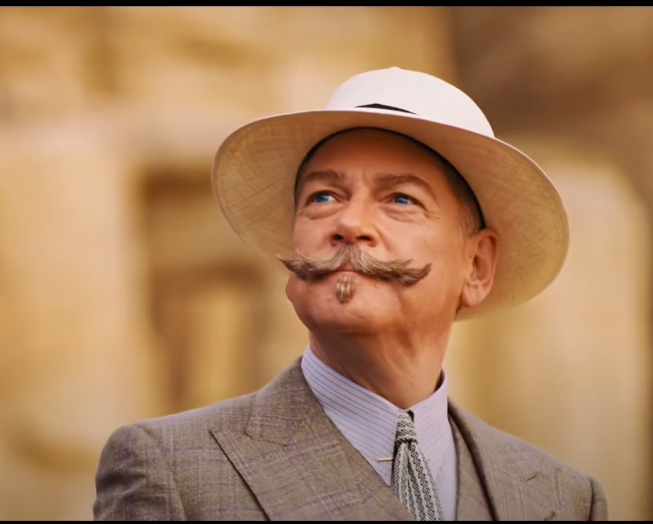
Stack also seems to have the same approach. Like a stereotypical Italian gangster, Stack is flashy and a bit dandy, wearing both a collar bar and tie clip. It’s a fun way to show off some accessorizing but their use does feel a bit off as there’s no need for a tie clip when you’re wearing a waistcoat (as the waistcoat will prevent the tie from flopping around), though as we can see, there were a few snazzy dressers who said “fuck it” and wore one anyway. However, it still stands that the collar bar is placed too low, preventing it from pushing the collar points together, making the tie knot pushed up and prominent. The “too low collar bar” tends to happen a lot in modern period films like Death on the Nile.
What’s most interesting about Stack is his chalk stripe suit which if you look closely, isn’t like the ones you typically see. Not only are the lapels a bit oddly shaped (looking like a slim Tautz lapel) but the buttoning point is very high (close to the sternum) and features three buttons close together. These are details found on “jazz suits”, a novelty/trend garment in the 1920s. This is an intentional move by Carter, who mentions in Harpers Bazaar that they based the suit on ones from the 1920s. It does make sense for the more positive and showy brother to wear such a bold suit. I could almost forgive the “overly coordinated” use of a matching striped red tie and pocket square, though if we read Stack as self-conscious, this could be intentional.
Stack also uses his fedora to emphasize his favorite color, red, which is also found in the spearpoint shirt, tie, and pocket square. The upturned brim does feel a bit Capone-esque, which is likely to emulate the homburgs (which have a stiff upturned brim) that were still popular in this era. However, the wide brim and short crown make the hat look more modern, looking closer to something you’d see from Optimo or Stetson. This is because 30s fedoras had a medium brim and a slightly taller crown, which had a more angular and dynamic look. I do wish films were able to properly invoke true vintage fedora proportions; it would have been cool to see Stack in a true 30s proportioned fedora in a burgundy felt!
As the film goes on, Stack undergoes a few costume changes, keeping with his dandy persona. Once he’s turned into a vampire, he makes a point to take off his shirt (likely bloody and ripped when he was with Mary) and just wear the waistcoat from his suit. Smoke echoes this by stripping down to his ribbed tank, a different but similar look. I guess you can’t stop the twin telepathy!
In the epilogue, Smoke’s diva status (as well as a bit of humanity) is still there, as we see him pull up to an elderly Sammy in a glorious Coogie sweater and rectangle sunnies. It seems that even when he’s undead, Smoke can’t help but stunt on everyone in the room.
Overall, It’s really fun to see great vintage costuming and specific character dressing in a movie that isn’t a serious period flick. It really is hard to believe that such cool attire is in a vampire movie! But that’s the thing, isn’t it? Sinners isn’t just about surviving a vampire attack, nor is it a drama about sharecropping, racism, gangsters, or even about the power of music. This movie is about all of it. It can be a lot at times as it waves through each genre, but the result is an intelligent and entertaining film. I certainly enjoyed watching it (twice), and it’s no surprise that it’s taken the world by storm with its story/themes, let alone its cinematography, humor, and performances.
I’m glad that the care and intention the filmmakers had extended to the attire, which makes this a fun watch from a menswear perspective. Who would’ve thought that we’d see a reproduction novelty jazz suit in 2025! It’s also interesting to see a different side of 30s menswear in general, one that gets to contrast the fun sartorial details with the “make-do” approach of the working class, Depression-era South. Oh Brother, Where Art Thou comes to mind, but that’s obviously a different type of film (that we will cover at some point).
Spencer, MJ, and I discuss the style of this movie in the latest episode of the bonus pod! We also talk about the tailored clergy attire of Conclave at the top, which you can listen to a clip of above. For the full episode, you’ll have to subscribe on Patreon!


Thanks for listening and reading along! Don’t forget to support us on Patreon to get some extra content and access to our exclusive Discord.
The Podcast is produced by MJ.
Always a pleasure,
Ethan M. Wong (follow me on IG)
Big thank you to our top-tier Patrons (the SaDCast Fanatics), Philip, Shane, Henrik, Alexander, and Mason.
 a little bit of rest
One comment