
As I continue to reflect on the “why” behind wearing classic menswear, I’ve noticed that I am continually fascinated by how people describe their approach to menswear. I think it’s important for us to relate how we get dressed to other things we enjoy in our lives, because clothing can be personal, fun, and ultimately expressive of our interests, personality, and overall demeanor.
You might think of that approach as a no brainer, but it’s a fact that most menswear content on the internet tends to revolve around min-maxing, which is the process of using the least (minimal) effort possible for the maximum possible benefit (which are mainly social in nature, such as attracting the most amount of mates or being considered “cool” to a majority of people). Fun, enjoyment, or self expression aren’t a part of it, at least not held to a high or equal priority to the external social benefits. The drive for a pragmatic and traditional end goal tends to echo hustle culture, the Big Tech mindset, and even hints at incel-adjacent philosophy (like looksmaxxing).
By now, everyone should know that I consider wearing menswear to be a hobby (that also happens to serve a practical purpose of not being naked). Collecting clothing, be it vintage or a modern custom commission, pairing items together, and wearing them out and about is a pastime that I enjoy very much. I also take it very seriously, at least to the point where I have a distinct taste and desired expression in what I want from what clothes I wear and how I wear it. These things always lead me to compare this hobby to film costuming or film scoring, except that I do not do either of those things professionally and none of my menswear activities are meant to generate an income (I think of Patreon as an optional tip jar that has no effect on how much content I make or what I wear).
I truly believe that the focus on traditional social benefits as the main reason for getting into menswear is a bad thing and detrimental to its continued existence. That’s why we should do our best to make a case for approaches to menswear that do not rely on an overly pragmatic, min-max way.

I know that this is nothing new to anyone reading this, but I always feel like reiterating this every so often simply based on the constant discussions I have about it. This latest one was inspired by a recent post by Patrick Hall, better known as “therevdmr” on Instagram.
I’ve been following Patrick for years (I think I first saw him on the Fedora Lounge or some other vintage Facebook group) and he’s been quite notable to me simply because he gets into the spirit of the Golden Era (and Esquire Man) with his attire. He accomplishes this by being a true fan of menswear and wearing a variety of garments across different eras. You’ll see that he wears Steed Bespoke, vintage 30s-40s attire, vintage Brooks, custom spearpoint collars, custom spread collars, Spier & Mackay, vintage ties, modern ties, Ring Jacket, and so on. Even though he tends to lean on the “trad” side of menswear (aka stuff with suits, jackets, and ties), it’s clear that he likes to express himself through the variety of avenues afforded by classic menswear.
The post in question was the above thought and outfit that he shared on his Threads: “I like to think about dressing as solving fun equations. For instance, I wanted to wear this hopsack blazer. But wanted to dress it down a bit. enter chambray shirt.”
Right off the bat, I like that this succinctly describes how a hobbyist gets dressed. It seldom starts with formality, presumably because we know that we can wear whatever we want and it will be socially acceptable (that is the inherent benefit of classic menswear, at least in large strokes).
Instead, Patrick explains that the impetus for the shared outfit is his desire to wear a sportcoat. Seems like an obvious choice for any trad dresser, but what helps make this into “solving a fun equation” is that he also explains that he wanted to wear the blazer…and be a little dressed down. It’s a small challenge considering the perceptions of tailoring in the modern day, but that’s where the chambray shirt ( casual fabric rooted in workwear) comes in. It’s decidedly not casual by most people’s standards (as the shirt is still a spread collar and he wears a solid tie) but I’d argue that the outfit still dressed down compared to when he wants to dress more formally, like a 3PC suit or blazer with a poplin tab collar.
Overall, I agree with his sentiment that getting dressed is about having fun equations that you set yourself the challenge of solving. But doesn’t this math talk sound suspiciously close to min-maxing? After all, the point of min-maxing (and other mathematically pragmatic approaches) is about solving a problem in the most efficient way. Is that what’s going on here?
No, I don’t think so.
I don’t think that framing getting dressed as a “fun equation” is remotely similar to min-maxing. While I admire people being anti-STEM when it comes to getting dressed, I think that this tends to present a problem with semantics and preconceptions about using STEM related words when describing something personal.
The main difference lies in the end goal. Min-maxing tends to focus on finding the most correct answer to remove guess work later on; it’s all about removing all future effort. Patrick doesn’t seem like that guy. This whole thing is about making an outfit that reconciles his inspiration (wearing a blazer) with additional challenges (being “dressed down”). These things are internal drivers, making this a case of utilizing taste rather than serving the mainstream or being in pursuit of external benefits, which is the goal of min-maxing.
I also don’t think that the presence of “shortcuts” by leveraging coded things, like chambray or denim shirting and linen or corduroy suiting being considered casual (compared to poplin and worsted wool respectively) in the realm of classic menswear, is enough of a “gotcha” to make this a min-max. Yes, such moves are something we can easily rely on but that doesn’t mean its overly formulaic. These things can be built on and combined with other coded items to create an outfit that is an amalgamation of vibes. That very fact that the resultant outfit is not straightforward goes against the entire point of min-max.
We also can’t forget that this whole thing relies on subjective tastes and expressions. Patrick’s outfit is not meant to be distinctly casual. He could have taken a step further and pair the blazer with a roll neck or a tee shirt if being supremely casual was his priority. No, Patrick wanted to simply “dress it down”, which for him and his style meant simply changing the shirt fabric. He is very aware that a jacket and tie will still read as “formal” to other people but what matters is if it matches the fun equation that he set for himself to solve. Again, this whole thing is about taste. Subjectivity is against min-max.
This discussion came up again in regards to the above post from Architectural Digest. The post is about how Argentine designer Sebastian Zuchowicki used the term “formula” to describe his process in working with clients. The way Zuchowicki talks about using a locked-down process can seem very pragmatic and rigid. But I also don’t think this is a form of min-maxing, despite his work being for an external purpose (the client).
To me, Zuchowicki seems to be referring to taste, which is strong and gets to be leveraged when working with clients. In fact, you could probably say that people engage him for that very taste and how he uses it to approach these “challenges”. The post talks about his latest project which was indeed a challenge as he was tasked “to turn a white, modern space into a home and warm it up through scale and texture, while honoring the vision laid out by the famous Japanese architect.
Again, I can see how the use of the word “formula” can be a red flag for min-maxing or an overly STEM mindset, but it’s clearly not how it’s being used by the creative in question. In discussing this stuff with my friends (who are not all fashion or creative people), they even teased that this is what happens when a non-STEM person talks about STEM; in other words, they would not have used “equation” or “formula” the way that Patrick or Zuchowicki would have.
Perhaps “puzzle” would have been the better term to use, as puzzles feel more “fun” than simply using “equation”. The fun comes in the process, the multiple tries it can take to accomplish your self-imposed goal. However, I can see the counter point being that despite puzzles being fun (with a variety of methods you can take to work through it), there is always an objectively correct answer.
This is why I like to use music when I describe my approach.
Composing music is an interesting self-imposed challenge, akin to writing poetry or taking a photograph. While pragmatic objectivity can come into play with the technical performance, the overall work tends to be evaluated in terms of expression. In other words, there is no “correct” song, just a song that expresses what a composer wants to express. That is a goal that you can’t min-max toward, especially when you want to accomplish a variety of things (which again is against the whole point of min-maxing).
For example, I may want to compose a piece that sounds like it could be from a Western. However, I also want to avoid banjos and guitars simply because I don’t want to. How do I accomplish this task? This means I need to pay attention to melody lines that are coded to be Western (or cowboy-esque) and give it to instruments that work within my chosen frame. But there’s even more to consider. What if I want it to be rugged and masculine? Or what if I want to excuse the optimism of the 50s/60s scores to The Magnificent Seven and The Cowboys? There is no correct answer, just one that fulfills what I want. The kicker is that in a few years, I could write a totally different piece that would still express the same qualities. The very fact that this is possible is what doesn’t make this a min-maxing problem. This is the beauty of writing music.
When I get dressed, especially through the lens of Cinematic Dressing, this whole process is the same thing as composing music. Hell, it’s almost as if I’ve replaced my hobby of composing music for no reason but my own with the act of making outfits for, well no reason but my own.
Just like Patrick, I give myself a challenge that is usually brought on by inspiration. I may want to dress like a yuppie…but I also really want to wear a vintage 30s tie and not rely on my dad’s old Armani pieces. I may want to wear a fedora but avoid relying on the tried-and-true silverbelly and western styling. I might want to wear sneakers but I don’t simply want to wear jeans. I might want to wear a sportcoat but I’ll also want to wear shorts but without looking preppy. Or maybe one day I’ll want to look preppy. Who knows what challenge each day will bring?


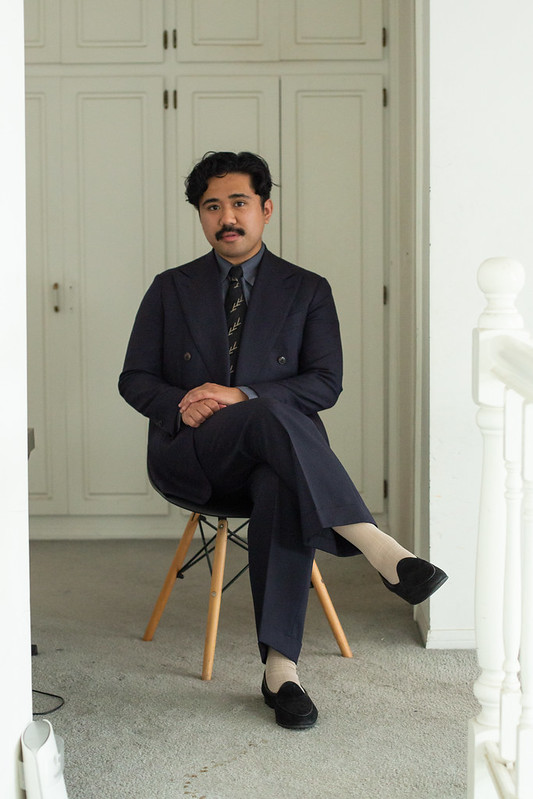


These challenges can sound wildly unnecessary and are admittedly, easy to avoid entirely, but that’s the entire draw of getting dressed intentionally and with your self as the priority. The challenge is fun and the starting point and framework changes all the time. Sometimes it’s all in broad strokes and sometimes it’s about doing what might be considered the same thing as before but it happens to have something else that makes it new (at least to me).
And yes, there are certainly coded things that serve as vibe shortcuts better than other things (like being aware of what makes an outfit to be perceived as formal or “dressed up”) , but they are hardly things that are overly pragmatic in an external way. If anything, they are only pragmatic in accomplishing my own internal goals. And when subjective internal goals are the point, this isn’t exactly the same thing as min-maxing, at least in the same sense that STEM-bros would use it.
The best part is that there is no true solution to any of these challenges, because like with composing music, there are millions of “solutions” to these self-imposed challenges. The only “right” answer is the one that felt right and expressed what I wanted…for that day. This is best explained in my reflections on what I wore to a 70s club but I do try to explain my thought processes on any outfit I share on this blog.
Ultimately, whole point of me writing this is because I will always think it’s important to share a mindset where getting dressed isn’t just about fulfilling a pragmatic need like dressing for a job interview or a wedding. It isn’t even about finding the ultimate outfit that you then wear ad nauseam. This is about celebrating the self-imposed challenge to ourselves: to make (and wear) the outfit that fits our mood and expresses what we want it to express.
Don’t get me wrong– this is not to discount the situations where people can rely on pragmatism. I am just saying that those are not interesting to me nor do they ultimately guide my participation in classic menswear. This whole thing is about the freedom and inviting challenge that comes with being free of externally presented restrictions. Everyone knows John Williams’ iconic film scores, which blend his own taste with the needs of the film, but people tend to not know that he has written pieces for the concert hall, such as his concertos for Horn and Piano. In an interview with Gramphone Williams says, “’I’ve always felt that my efforts in [concert works] were more than anything exercises in self-instruction and self-development, and presenting myself with opportunities that I wouldn’t have in the restricted areas of composing film music.” I would say the same thing– the efforts I make in my outfits are about myself and my own relationship to menswear.
The beauty is that the work is never done. There is nothing to properly min-max because our inspirations, priorities, and desired expressions changs all the time! The whole point of approaching this as a hobby is to embrace the parameters we give ourselves and take pleasure in “solving” these challenges, even if we know nothing is truly solved. Not everyone wants to do that, but I still believe that we should make a case that getting dressed can be fun and a be hobby worth considering.
I will say that I do fear if I will ever get fatigued from doing these challenges. After all, I did all but replace composing music with this little menswear hobby. I only write one thing a year. Will I ever get to a place where I rely on repeating tried-and-true combinations and only intentionally make a fit once every 365 days? I certainly hope not!
Thanks for reading! Don’t forget that you can support me (or the podcast) on Patreon to get some extra content and access to our exclusive Discord.
Always a pleasure,
Big thank you to our top tier Patrons (the SaDCast Fanatics), Philip, Shane, Henrik, and Alexander.
 a little bit of rest
Ethan your overly wide legged brown linen pants are most interesting… Why don’t you try wearing medieval clothes like a long drapey robe with a belt instead. With the same width to the skirt of the robes as your linen pants trouser opening so to speak…?
LikeLike
Loved the blog, you should definitely talk about the clothing in Oppenheimer, a feast for the eyes!
LikeLike