
I am very aware that I have gained more than a few levels in pretentiousness ever since I started reading books and undertaking the absurd notion of relating them to menswear through my blog. To be clear, I’m not trying to be a pick-me and show off my artsy, non-fiction interests. No, it’s much less dumb: I’m just looking for validation for my menswear philosophies and it’s clear that artists and composers are the closest thing I have to that. See? That’s totally not absurd and narcissistic at all!
But in all seriousness, I have often wondered why I find camaraderie with these types of texts. On a surface level, it’s because I not only want to feel like I’m not crazy (the jury is still out on that one) but if I look deeper, I do think that I want to feel inspired and positive about this silly little thing that I enjoy. Reading about music and art just reveals things to me about myself, putting my instinctual mindset and non-pragmatic beliefs to [largely] concise words. This helps me out because approach to clothing is more about self-expression and always vying to be separate from work-attire or trying to monetize off of it, artistic endeavors really are the closest thing to what I like to do (maybe cosplay would be better, but I know you guys hate that term).
It’s just more interesting to me than reading the history of garments (knowing that a blazer has military origin doesn’t exactly inspire me) or reading a list of things people are excited to wear that happens to be full of affiliate links; I also don’t always want to just look at a brand’s lookbooks (though my inspo archive is basically a form of that, just without the ability to instantly buy the garments found within it). I just want something to spur general inspiration and excitement for life!
I know this whole thing still is quite silly (and absolutely pretentious), but I really like it. Isn’t sharing what we like and why we like it what this whole blog is about?
I bring this up because I just finished reading yet another book about music that really stuck with me. And believe you me, it may just make me out to be even more pretentious. The book itself is not (it’s a very positive and concise read), but I’m sure you will all have a problem with the fact that I leaped at the chance of relating it to the fun activity of Getting Dressed. The text in question was Music & Imagination by Aaron Copland (the composer!).
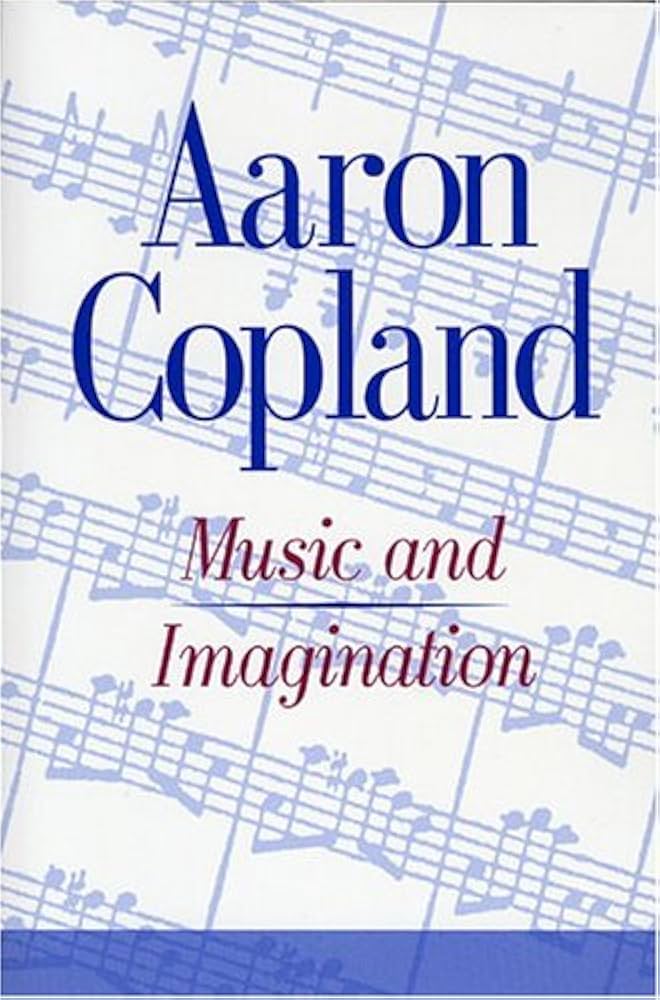
Imagination
So much of the book echoes what I’ve always believed about the hobby of Getting Dressed. And so what follows are simple points that I think bear sharing if only to have it canonized on the blog to reference later. Again, I hope that it is is inspiring for you as it was for me. Not only to help us feel validated in our approach, but to not treat this whole thing like pragmatic bloodsport or a daily obligation of not-being-naked. There is room for fun, for art!
Now, the title is a bit of a misnomer as the text only briefly talked about imagination right at the beginning. But boy does it set the scene: “An Imaginative mind” is essential to the creation of art in any medium”.
Imagination for Copland relates directly to the section on the “sonorous image”, which is an abstract idea of what the composer wants the music to sound like and is a manifestation of what they “hear” in their head before the notes are put down. “The creation of a satisfactory aural image is not merely a matter of musical talent or technical adroitness; imagination plays a large role here”. It is here that the biggest connotation to menswear can be made. Imagination is truly the theme behind this activity, to envision what you want to look like (i.e, the “thing” you want to “make”) and to execute on it (make it). The best fits, the ones that we connect with at least, are the ones that are simultaneously an idealization of our ideas that seems wholly “us” and in order to do this, we must have imagination.
That is why Copland relates music to poetry, much like how Tim Carpenter did with photography. At the top he makes a call for an emotive life (hell yeah) of which music (and the arts) plays into. Copland tells us to avoid making “paper music” which is the “worst reproach you can make against a composer”. It seems that having imagination and intention is what indeed makes this a deeply personal undertaking that should be taken on with all of our being.
Audience & Being Critical
Of course, this brings up the topic of audience, something that all art, including the hobby of making fits, must always play with. Copland describes his ideal listener, which is not the niche professional nor the general masses. No, Copland is excited most by the Gifted Listener, the one who is at best, an amateur who lacks preconceptions and prejudices but who still has a sense of innocence and intuition. When they listen to music, they get both the “event” and the idealization of the “event”, being inside as well as distant. It’s about pleasure and understanding, to have some insight into the nuances of expression, such as delicate joy vs. troubled joy. Such listeners are the best for composers and I would say the same thing for the hobby menswear.
To me the Gifted Listener is the person who has taste who isn’t necessarily working (or aspiring to work) within the menswear industry or to be an influencer. Hell, they may not even be the ones who actively get dressed on the daily! But the difference between them and a person going through the motions is that Gifted Listeners pay attention. They are introspective and aware of various forms of expression that are not limited to (or specifically) for fashion. And in my experience, these are the ones who “get” menswear the most.
It is here that I believe menswear survives and thrives; tailoring doesn’t just get to live at Pitti Uomo or in brand lookbooks. Interacting with these types of people just makes for more productive conversation, one that allows imagination to thrive while keeping things grounded and accessible. To me, the very fact that non-menswear people can still get the vibes of what I’m trying to do is proof that this whole thing can be instinctual, though it helps that I try my best not to dress just as a shout out for vintage enthusiast as well as not in pursuit of technical or formal proficiency.. It still happens, but I aim to achieve a vibe (or emotion) from my fits. Achieving the imagined image of my fit is what matters and it almost always is a more abstract and yet tangible approach to aesthetics.
This is why being critical is so important to imagination and what keeps us in check. Audiences (especially Gifted Listeners) factor greatly in creating any work, but we also need to prove we are right in our expression not only to others but to ourselves. This self awareness of leveraging expressiveness is a constant journey that requires constant evaluation of our work and the context it was made and exists in.
Copland levies some critiques against certain composers (usually young ones) who are not aware of the role of criticism. Not only are they not aware that each successive note or chord is a decision, but that they aren’t aware of how each of those things plays into the “psychological and emotional connotations of their music”. Instead, they are focused on the “formal rightness of a scheme”, which is rigid and not “sufficiently cognizant of [what has a] controlling influence on the success or failure of a composition as a whole. Of course Copland concedes that music is subjective and that it can be difficult to ascertain whether or not the audience truly has received your “message” correctly.
The answer doesn’t lie in making one more important than the other. Self-critique and a learned audience (that is not professional) is the way to create a positive environment where messages are being shared accurately (or at least close to it). There is inspiration found in an audience that is intuitive and discerning as well as in the exercises of self-awareness that we put ourselves through. In the end, we will always have some sentiment to build off of as we will know what is truly pertinent to our creative goals. This creation of a positive back-and-forth has not led to confusion, but to insightful dialogue and continues to produce “good and vital” things.
As Copland says, “the indissoluble link between interpreter and composer makes their interaction one of the conditions of a healthily functioning musical community.” These Gifted Listers may lack professional lexicon, but they are still helpful in allowing the composer to learn about the character of his work and see aspects of it that he did not realize were there such as “tempi that are slower or faster than he had himself imagined were the correct ones [or] phrasings that better express the natural curve of a melody”. And believe you me, a lot of my style (as well as the confidence in my choices) are from such interactions with Gifted Listeners. As my experience with my non-menswear friends in my gamer circles or in the SoCal Asian American discord that I’m in shows, a lot of people are Gifted Listeners.
These people don’t need to know about the plethora of details found in menswear history or to be tapped into the relaxed takes of Armani or Adret to understand the vibe that I am after. The conversations that we’ve had reveal that they think about taste and are aware that items can be coded, which can be played into or subverted as a wearer sees fit (similar to music or writing). They can see the expressive merits of specific garments and how they play into the whole, as well as see the nuances between each outfit. Granted this happens after repeated hang outs, which is something that some menswear stalwarts forget can happen (it is not bloodsport nor is this a one-time chance to make an impression, things will be okay). It makes me wonder if certain menswear guys hang out (not just interact) with non-menswear people.
In the world of the internet and the gradual acceptance of non-pragmatic dressing in the menswear space, we end up asking the same question composers ask themselves: “who are we making this for”. I have to agree with Copland, while we are always glad that anyone (niche or not) can enjoy what we have “made”, it is who we are excited about that is the most telling in our prerogatives.
Like Copland, I am drawn to the Gifted Listener because such people can enjoy it for fun without being ignorant and without having to firmly be a professional in the world. Though granted, in this hobby, being interested in this stuff without working in it really just means you are actually in it, but I think Copland would simply make this out to be the musical and arts community at large.
Even though I am not about overt proselytizing, I hope that some things I do result in more people becoming (or realizing that they already are) Gifted Listeners!

Creativity & Creation
The other main theme of the book was on creativity, which to me seems like the act of executing on your imagination and audience. And yes, a lot of this works with menswear too!
In chapter three, Copland ponders on a very important question: “Why is it important to my own psyche that I compose music?…Why is the creative impulse never satisfied[?]” He has an answer, one that is definitely not meant to break new ground but rather to simply put the matter to bed (at least for himself). He says that composers are in the pursuit of self expression, the “need to make evident one’s deepest feelings about life”. This is never done because “each work brings with it an element of self-discovery. I must create in order to know myself and since self-knowledge is a never ending search, each new work is only a part-answer to the question ‘Who am I?’”
I feel like I’ve hinted at this entire thing with menswear. While we are limited by the expressive features of our clothes (much of which is due to coding that is out of our control), our outfits do share something about us even if it isn’t as grand as a symphony or a poem. Clothing still affords us quite a few nuggets to leverage in our expressive goals; once you understand how styling pieces as well as how silhouette and structure factor into vibe, you will find that you definitely can express feelings and vibes as you see fit.
To me, this is the joy of clothing and its companion activity of making outfits as it applies directly to expressing something about me each day. I am perfectly fine with it not being everything, but that’s what words and physical actions are for. Clothes just give us another element that we can leverage for our expression.
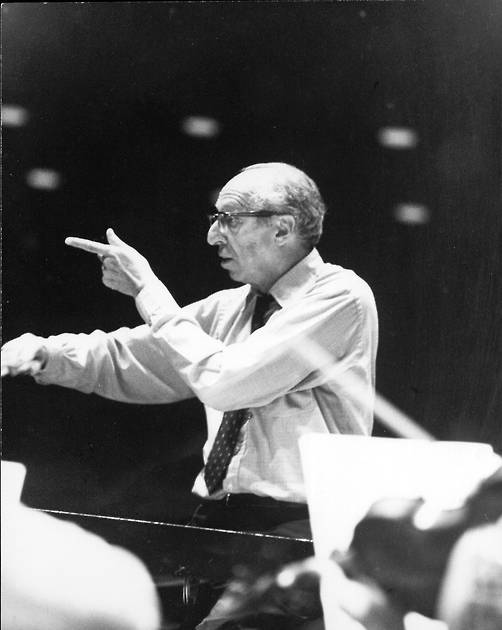
When Coepland brings up Jacques Maritain, he then leads us to another interesting point, He says that while the need for self expression is ever-present, a composer “cannot, by an act of will, produce the work of art. It must either be entirely spontaneous…[or] induced, gradually perceived so that each day’s work may spell failure or triumph.” This tells us quite a bit about how Copland views creativity and creation, namely in that it will always be compulsion and not something that we can use pragmatism for.
This need for inspiration and spontaneity calls to mind my previous blog post on the philosophy of Photography where I share how I immediately make outfits as the idea comes to mind. This is different from planning, which I view as making outfits in advance for a specific occasion. Instead, I put garments together whenever inspiration hits.This makes it quite reflective of a mood and perhaps the closest way I can get clothing to have kinship with photography and composition.
I am just lucky enough that in most cases I am able to wear them to whatever I happen to be doing each day (weather depending). I could just photograph the outfit and take it off, but making an outfit is only a part of the whole hobby– I want to wear the clothes out (and for as long as possible). This is one of the many aspects that makes clothing a different pastime and not a 1-to-1 with composition (but that’s not a surprise). After all, my approach to menswear is about expression with existing things rather than designing something from scratch (which would perhaps make it much more closer to music or other fine arts).
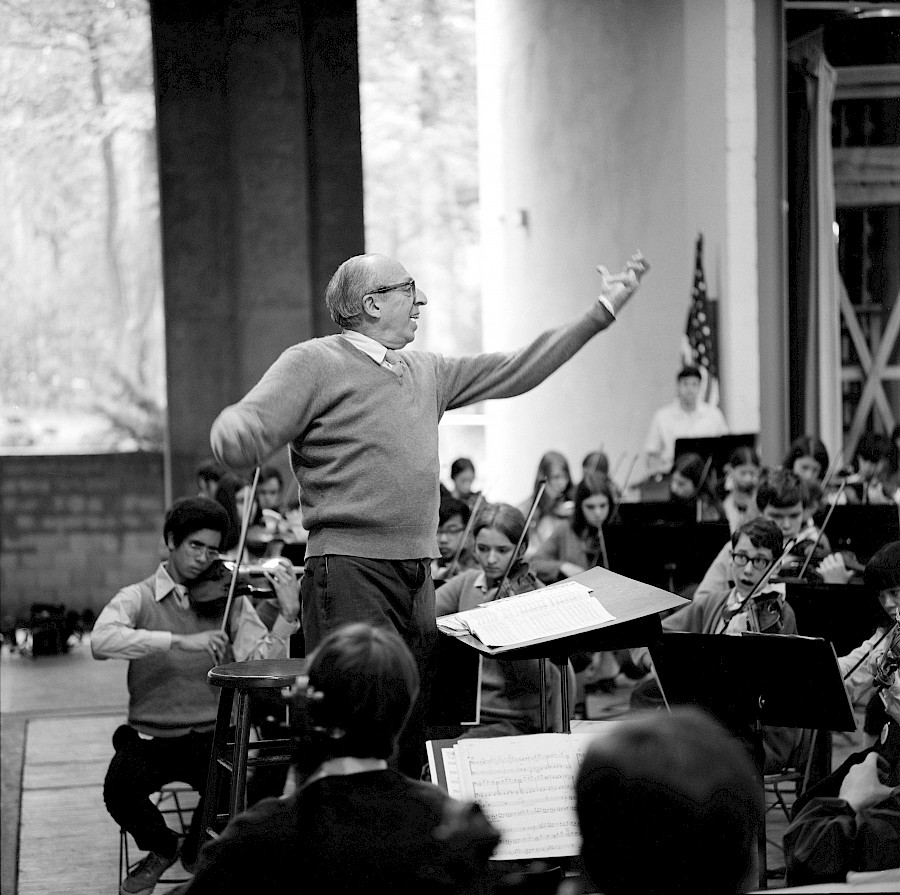
As you can tell, I really enjoyed this read. Even though a lot of Copland’s rhetoric is idealistic and naive especially compared to other critics (he also has a few problematic references in the book) , I find a lot of kinship with his overall views on creating and a work’s relationship to his audience. And while the idea of relating the philosophies behind composing music and the hobby of wearing clothes is very absurd, I do not think the merit is misguided. At the base level, we are simply doing something to express ourselves. It is not that clothing is the same thing as writing music, but that clothing is a valid activity we can do in order to express some aspect of ourselves.
This is best put when Copland describes what happens when he “puts down notes”. It is a “reflection of emotional states: feelings, perceptions, imaginings, intuitions”. This is what I want to share every time I put together my outfits. I want it to be in conversation with my mood, my interests, my aspirations, my cosplay-ness, my fandoms. I do not want to dress simply to adhere to formality/appropriateness or social aspiration (both of which I tend to fail at anyway). I want it to be me! That’s what I want for other people to enjoy as well.
Art and the life of art must mean something to everyone. This is the goal and benefit of an expressive life. And I definitely think outfits are a fun activity that help us do that!
God, all of this just shows me that I need to spend more time actually composing music instead of writing about clothing.
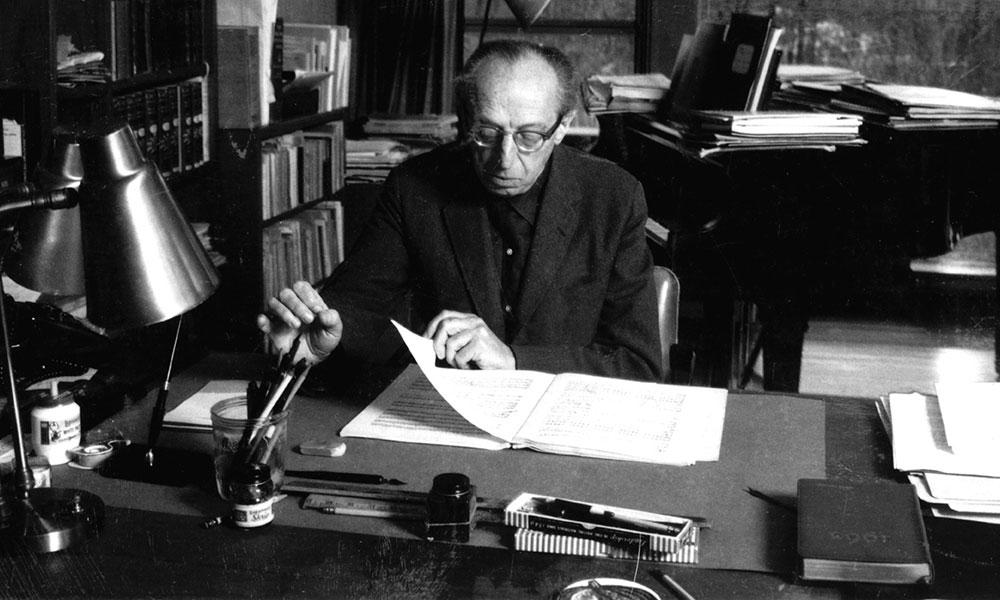
Before I close, I want to share something else I liked about this (that didn’t fit into the other sections of this blog). It was a tangent on the creative problems found during orchestration, Copland gives us two approaches that work out well as philosophies on creating outfits. The two approaches are:
- Thinking in color at the moment of composition.
- Choosing color after a sketch of the work is at hand (usually just the melody).
When I first read it, I thought that “thinking in color” was the superior course of action. After all, most of my inspiration tends to come from a holistic outfit, which means that all I have to do is put the pieces together instead of deliberating on them one at a time. After all, most composers (at least in Copland’s time) don’t have a sketch, they compose directly onto the score “thinking the timbre and the notes together”.
This method sounds intentional and certainly easy in helping achieve the “sonorous image” much quicker. However, upon a reread for this blog post, it seems that there is underrated merit in “choosing color”. This is because it allows you to really think about each component in relation to each other, making it deliberate instead of being tied to the decisions already made when “thinking in color”. You lose out on the freedom from properly providing ample development in the music. Copland posits that it’s probably best to do a mix of both, perhaps even stopping yourself from “thinking in color” until the moment calls for it, such as when a phrase or section inherently suggests its orchestral form.
This was an interesting concept for me to apply to menswear as it really makes me think more on how I make outfits. Perhaps it would do me good to work more on vibes (the “sketch”) and allow each piece to come together, as it may reveal more about the expressive relationships between the garments instead of simply doing “the whole” right away. That’s going to be quite a challenge, but it might be one I look forward to doing!
After all, I’m already challenging myself to make more time during the week for decidedly casual outfits (outfits that don’t rely on collared shirts with ties)! The concept of thinking vs. choosing color may even help me out on this new activity!
There is another interesting part near the end where Copland admits that he aimed to contribute “American” sound of symphonic music and to make something that could be considered a “vernacular” which would cause no difficulties to his listeners. This calls to mind Derek’s assertions that classic menswear is the lingua franca of clothing. While I do not think I dress in a “simple” way, I do think that my style is quite easy on the eyes and most people get my slouchy and easy-going vibe right away, especially if they interact with me directly. I definitely think my outfits (when seen on me) are not difficult to understand or are inaccessible ideas. It’s all there!
Copland wanted to make a connection between music and his life. I definitely want the same thing for my life and my outfits.
Thanks for reading! Don’t forget that you can support me (or the podcast) on Patreon to get some extra content and access to our exclusive Discord.
Always a pleasure,
Big thank you to our top tier Patrons (the SaDCast Fanatics), Philip, Shane, Henrik, and Alexander.
 a little bit of rest
3 comments