
This is a recap-ish of the latest podcast episode. You can listen to the episode below before or after you read. That’s because I tend to expand on topics from the pod as well as straight-up write about things that we did not discuss. The choice is yours in how you want to proceed!
- Anime Los Angeles – 3:27
- Pitti Uomo – 15:09
- New Year’s Resolutions – 23:30
- Vintage isn’t Gatekeeping and Why Effort is Good – 46:31

Hello, my friends!
What an odd introduction; I guess I’m not used to writing intros that don’t start with a personal anecdote or some sort of self-imposed, argumentative debate topic. I told you guys changes would be coming in the new year! In that way, this latest pod is full of fun topics that don’t really require my long-winded touches, apart from the last part (listen to the damn pod). But before that, let me recap (and add some thoughts to) some of the things MJ, Spencer, and I discussed in the latest episode.
We start with MJ recapping his experience at Anime Los Angeles, which, when compared to Anime Expo, is the biggest “indie” and community-focused anime convention here in our city. Enthusiast gatherings like this are always quite interesting to discuss, because even though it’s not strictly about “fashion”, what you wear to such a thing is a fantastic example of expression and semiotics. For example, do you go full cosplay, go for a “bound” (a lightly, more “regular clothes” version of an IP), or simply wear the merch of your favorite show or Vocaloid? There’s no wrong answer!
One big component of ALA that I found wonderfully fascinating was the ribbon tradition. Like Disney Pin Trading, it’s a wholesome community activity where vendors, artists, and enthusiasts alike create and collect unique ribbons that reference your favorite characters, games, memes, and even the meta of “conlife” itself. Each day, you attach the ribbons to your con badge, and the game is often to see just how many ribbons you can amass; some attendees keep the same tapestry going year after year, ultimately becoming a vibrant and wonderfully monstrous shoal full of your favorite references. As someone who wishes more people did senior pants, I find so much kinship with this tradition. It really gets at the fun of being able to wear your fandom and community quite literally on your sleeve.


Speaking of conventions and community, Pitti Uomo (Autumn/Winter edition) was this past week, and I…didn’t pay that much attention to it. It’s not that I have an issue with Pitti (it seems cool and maybe someday I’ll finally attend!), but as you probably surmised from the last time we discussed it, it just doesn’t play much into how we engage with menswear, at least today. Pitti is still primarily a trade show and a media event– and the SaD boys and I aren’t exactly menswear insiders. We’re currently too focused on rebuying the same items and wearing old outfits to eagle eye what everyone is wearing to strut around the Fortezza.
It wasn’t always this way. It used to be something I looked forward to! When I was younger, Pitti felt like another world, a special, rarified shindig full of people wearing pleated trousers and ties, let alone full suits. After all, classic menswear, or rather the ideas of it, wasn’t currently in vogue. In order to see the stuff I was into (and not just look at vintage photos and illustrations), I buried my nose in Drake’s lookbooks, by following the IYKYK guys (Ethan Newton, Tailor Caid, etc), and of course, religiously looking at the curated shots of Florence’s biannual trade show. By bringing together everything I liked in a physical place (in a bit of an MCU of fashion), Pitti was a place that made contemporary classic menswear “real”, to a certain extent. Of course, I got older, and the world changed. The menswear merger has made it so that Pitti (and the other places I checked up on) weren’t the only places to see some good fits. Good stuff, relatively speaking, is everywhere. Most current brand, influencer, and IYKYK personality takes after that classic menswear DNA, for better and for worse. In that way, Pitti has been lower on the list of things for us keep up with. Plus, with the fact that so many of our mutuals and IRL pals are a direct part of the show, we know that we’ll see some stuff across our feeds eventually.
On that note, the sample of what we did see was good. And as always, it’s certainly indicative of what the menswear world, in particular the classic menswear world, is feeling. Despite regular men’s fashion starting to approach the slim legs of the 2010s, classic menswear is still wearing their high-waisted, fuller-cut trousers. Vintage garments, styling, and inspired-repros are still the name of the game as men’s fashion continues to cannibalize the past, but it is still fascinating to see what elements people are pulling from (though it’s still quite 50s, 70s, and 90s) and the levels of coherence they choose to employ. In other words, I am glad that people are wearing what they like!
There’s also the hypebeast-esque, sporty-menswear mix that describes the NYC menswear scene (as well as TikTok) that continually has a bigger presence at the show. More and more big coats with hoodies, puffers over suits, and tweed jackets with 90s-wash jeans and an audacious cap. It’s what Jason Diamond dubbed “scumbag Ivy” and what is now going around as “Fake Ivy”; Ebima has a great article on the appeal and attitude of the look. It’s a perfect combination of perceived irony with a dash of earnestness, as those very ex-hypebeasts and Tumblr kids who grew up on Pitti streetstyle are now movers & shakers in the menswear industry and now find solace in their take on blending preppy, Ivy, trad, and all manner of Americana. I find their outfits endearing as a cheeky approach to trad, even if I prefer something a bit more earnest and less “meta” (but maybe I’m just boring). It is interesting to see the look outside of an American metropolitan center and in historic Florence, but that’s probably just the effect of social media making the world smaller. Perhaps someday, this rig will be as classic as the Pitti Peacock.
As always, our favorites to spot are the fellas at Bryceland’s and Anglo-Italian (as well as Beams and United Arrows), who often lean into having a defined and decidedly more cohesive aesthetic— this obviously aligns with our own style, so take our enjoyment with a grain of salt. It’s nothing major or groundbreaking, but Ethan in a Grizzly Jacket and Jake in a grey pinstripe DB (complete with a narrow knot tie) will always tickle our fancy. It goes without saying that this is the very reason why we don’t really feel the need to cover Pitti— we just end up liking the same type of things over and over. If anything, we are consistent people.

Unfortunately, the pod doesn’t have a Blessed/Cursed list like we did last year.
Truth be told, it’s quite a big ask for us to think about what we do and don’t fuck with, simply because the list doesn’t change too hard from year to year. We did do a small talk on New Year’s Resolutions, but they’re honestly quite tame. MJ wants to be a bit more intentional with his attire (especially as he moves away from retail) and might finally pull the trigger on a custom fedora (like a brown one for obvious reasons). Spencer is still trying to replace and repair his foundational items so he can wear more “interesting” outfits again. And for me? Well, I’m also looking to repair items, namely some of my footwear that are finally at that “resole” stage– something that I’ve never had before. I’ll be sure to let you guys know how that goes! But in terms of a Real Resolution, well, I’m always trying to be more casual despite my default still being some sort of shirt-tie-jacket combination. I feel for my beloved sportshirts and merch tees!
Of course, the biggest part of this pod came at the end, where Spencer, MJ, and I have a lengthy discussion regarding brands and effort. It was a great discussion that calls to mind similar points I made back in 2023, but like with outfits, I guess it bears repeating with updated context! If you haven’t already, I suggest listening to the podcast episode and reading my specific thoughts below for the full picture.


When I was in NYC (for an extremely short time), I went to Fanelli’s cafe with Yung Chomsky. After a great conversation about photography, namely about how photography content is seldom about personal style and more about gear or the lifestyle of a photographer (remind you of anything?), we naturally talked about menswear. Specifically, social media and menswear.
He and I both remarked that most of our DMs are filled with men asking where our items are from. This is far from a novel experience for any menswear enthusiast who posts their outfit publicly. To be clear, there isn’t anything wrong with this; in fact, I enjoy the interaction, since it shows that people enjoy my style enough to get one of the pieces for themselves. But what we both noticed lately is that the curious often become disappointed or even salty when we share the source…and it wasn’t Uniqlo, Banana Republic, J. Crew, Buck Mason, or any of the “main” brands that are often seen on the internet. And if the answer was vintage, they were even more annoyed. YC and I both found their response quite dismaying. It wasn’t the fact that we think those “main” brands are bad (we own items from them) or that vintage is inherently better, but that it was clear that the curious DM-ers just wanted something easy, something that could be found instantly.
In the spirit of being gracious, perhaps the respondent was simply disheartened because internet culture has made transparency and ease commonplace. After all, fashion creators have all been quite transparent with listing brands in a move away from gatekeeping. However, I’ve found that this has backfired, making people even more focused on brand names. It almost feels like an effect of post-hypebeast culture’s effect on menswear, despite transparency being antithetical to it. It feels as if knowing the brand (and the product name) is the end all be all to getting some swag, but that could be further from the truth– especially when it comes to buying vintage. It’s almost the point where saying that something is vintage or thrifted has been called out as a form of gatekeeping or elitism because it pulls focus away from the brand and potentially requires effort to obtain.
I couldn’t disagree more. Sometimes the brand doesn’t indeed matter…and effort is never something to shy away from, especially when you have a specific POV.


To be clear, I have nothing against brand-name items. I own a fair bit myself, whether it’s modern or vintage! Ring Jacket sportcoats. Alden shoes. Lee 101J trucker. Knowing the brand is indeed important, especially when you want something specific that only that brand makes, or when it’s something they specialize in. But at a certain point, brand names just don’t apply, and that’s mainly true with vintage clothing.
Most vintage brands, at least the ones that feature in a few of my garments, straight up don’t exist anymore, or if they do, they don’t make the desired garment anymore; as a result, sellers seldom include them in the listing! But even so, there are thousands of “vintage” brands, all of which would have made similar items during their era of manufacture. For example, McGregor made what Tiktokers would consider to be “cropped knitwear” during the 20s-40s, but so did Congress, as found on a label in my navy 30s sweater vest. Searching “Congress sweater vest” doesn’t yield anything, at least at the time of writing. But this isn’t a bad thing. After all, Congress, or the 30s-40s specifically, isn’t the only source of good, Ethan-friendly knitwear.
If you look around long enough, you’ll find that various sweaters from the ’70s to ’90s also look like they could be straight out of Apparel Arts. In my experience, these are often better than tried-and-true brands like vintage and modern Ralph Lauren (which are too long), both in terms of my style POV as well as the price I’m comfortable paying. The thing is that they aren’t “easily” found. Such gems are mixed into the swath of listings; being too specific with your search would mean you’d miss out on them. That’s why I like to keep things general (“vintage brown sweater vest brown”) and only click on something when it aligns with what you want. It’s not about the brand or the search term at that point, but what my eyes tell me. You might even say that having the eye for the right piece of vintage is there so that you don’t have to rely on the brand! Who would’ve thought?
The “work” goes into developing the eye for those desired details: high armholes, short length (relative to your torso), and wide ribbing. This knowledge isn’t gatekept; plenty of media (including my own) has been written about them, but most of it can come from simply being critical. In the case of this sweater, it’s about internalizing the 30s-40s and then being able to recognize congruous approaches in other eras and makers, so that you aren’t locked in only buying specific era clothing (or specific brand, etc). There’s always good stuff to be found if you’re patient enough!
Developing that critical eye also means you’ll learn what details you don’t want, which prevents you from being burned by a bad purchase. After all, a random “vintage sweater vest” you find on eBay may not be cut right for high-waisted pants or how a western belt may not be in the thin width that works for a midcentury (or 90s) look– but if I’m being honest, the ones I wear aren’t really considered anything other than a “vintage sweater vest” or “vintage western belt”. The same goes for most things in my wardrobe, like my “grey trousers” or “alligator belt”. Qualifiers like a brand (Brooks Brothers) or even a distinctive detail (3-roll-2 sack) contribute a bit, but not much; plenty of good brown plaid jackets aren’t necessarily sacks or need to be made by Brooks Bros. In other words, we are looking for garments, not brands.
And so in the end, these items really are just a “piece of vintage”– something thrifted or found on eBay. Even so, acquiring them still requires the eye to parse through the sea of clothes, as well as a helping of diligence and patience (or, in some cases, the right amount of cash, if the thing you want is still pricey). The effort, both to develop that discernment and its deployment during “shopping” was unavoidable. It’s all part of the fun– and for us, it is fun!


On that note, even going custom, which seems like it should be simple, tends to require effort on your part. In fact, it might be a bit more so compared to picking vintage or perusing the thrift, simply because you have to translate your eye for details into how you communicate with the brand you want to order from.
It does come off as misleadingly simple: it seems like all you have to do is go in, pick fabric, and then get measured up to get the suit that you wanted. While this is certainly the case with high-end bespoke, where the whole deal is indeed letting their tailor, and the House, take the lead. If Kirby Allison’s videos are anything to go by, a good firm will always ask good questions, encourage feedback, and explain what they’re doing to dissuade any apprehension. Of course, you should only go to a firm that aligns with your aesthetic philosophy; that way, you already know what silhouette and proportions you’re going to end up with.
Lower-end or internet MTM, which is certainly affordable/accessible, simply requires you to be get involved. After all, the person measuring you isn’t the one cutting the garment, which already has more of a disconnect. Not only that, but most MTM firms are intentionally more open-ended to allow for the maximum number of customers– and yet still try to steer you to what is the most “normal”, which is usually a mid-rise, slim fit suit. The good news is that because of their need to serve multiple customers, you should be able to get something that aligns with a specific look, provided that you are an effective communicator…and get to partner with a good salesperson. But in any case, there is still effort needed from you. None of this is meant to be passive!
My experience with Atelier Fugue and Suit Supply are great example of this. I have had great suits from both of them, but the process was certainly not as simple as giving them my measurements and letting the factory run. In the case of the Former (which was remote MTM), the final silhouette was achieved after years of tinkering with each subsequent order. This, along with the various alterations, gave me great knowledge of how each body and garment measurement worked together, which helped me hone in on what I wanted. Suit Supply was a bit different since I was there in person, but even so, I found that being able to try things on only made me more apprehensive, but it also let me be more communicative, since I could figure out what exactly was being changed (instead of the “ghost” garment in the case of remote MTM).
[Obviously, these experiences and their resultant intuition aren’t easily translatable, which is why I try to be there whenever a friend gets a suit made. Not everyone needs to be hyper-critical with their suits, especially if there isn’t a super-specific POV. However, people should at least learn what goes into custom and not simply do it mindlessly, that way they can develop that taste and hone it in or explore more in the future.]
In both cases, my garments deviated strongly from what those brands’ house styles or what they typically make. People are still surprised to find out that a few of my suits come from SuSu, of all places. What’s funny is that the last time I was in a Suit Supply (helping out yet another friend get something custom), another customer remarked on the SuSu suit I was wearing and told his salesperson to give props to whoever made mine. Almost instantly, that salesperson pointed at me and said, “Well, you have to give that guy some credit; he was just as involved as we were on this.” I thought that was very kind of them to say, though the story does feel a bit like r/AndThenTheyAllClapped. But it is true!
It was only through getting more involved that I was able to get some of my favorite garments of all time. If I didn’t, I would’ve ended up with suits that would have been “okay”, but they certainly would not have been the full cut, Apparel Arts-inspired (with a dash of midcentury Ivy and a 90s lean) look that defines my taste in suiting! But you know what? I enjoyed it! It is fascinating for me to learn about how all these elements and measurements play with each other. It helped me gain a deeper understanding and appreciation of my clothes, which I then get to apply to future orders or even when I look at things OTR.
Yes, there are plenty of “big suits” around via RTW (as well as secondhand sources), but they all vary in terms of leg taper, buttoning point, lapel shape, and the myriad of other superfluous-but-not-to-me details (not including price). Like with shopping vintage, this is about knowing what you don’t want and what your limits are there. Call it taste, curation, or the critical eye– it all requires a bit of effort. It’s educational and fun!


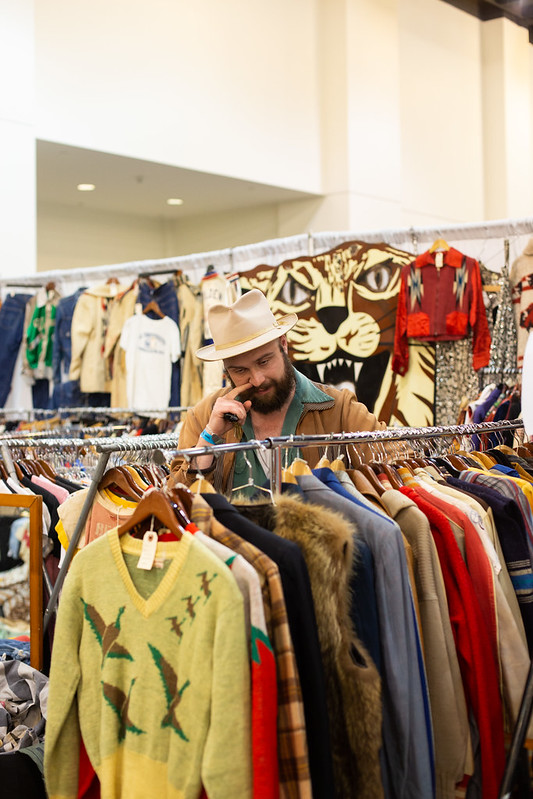
This renewed conversation on effort and gatekeeping shows me that, like most other “debates”, it all boils down to how we engage with clothes. If all you want is an easy way to achieve cool points or to simply not be naked, then none of this really matters. My approach is just different.
I’ve simply found that acquiring garments that really express your personal style inherently requires some form of effort, whether it’s being diligent on eBay/thrifts, understanding the impact of measurements on a suit, being patient for a sale, or yes, saving up for the thing you really want. Of course, this is turned up exponentially when your style is anachronistic and specific. Though honestly, the same can be said for similar, non-menswear things we enjoy: vinyl, furniture, bags, jewelry, or virtual instrument samples. Until what we like is available at the mall, we gotta put in the “work” to get what we want! In fact, I wouldn’t say that this is even about work or effort at all, but about not being passive.
I will always be on the side of the path that encourages being critical and intentional. Putting in effort to acquire our clothes gives us the opportunity to become more connected with the nuances of our taste, which then get translated into the clothes we own. In that way, it’s more about having a journey (I like that term more than “work”) with your taste and clothes; it can certainly be hard and frustrating, but it’s ultimately rewarding. Opting instead for being passive simply robs you of the ability to develop that type of deep connection. And so, because of those journeys, every garment in my closet is special to me, being a culmination of some sort of “journey”. This is likely why things haven’t really changed– and why I hate giving garments up. At this point, I’m certain that anything I will own (I’m trying my best not to buy more clothes) will also involve some effort.
To be clear, I don’t think that work is important for the sake of work. For example, I believe that college should be free and that people shouldn’t be forced to pay loans just because millions of people have paid theirs. That’s completely arbitrary and a true case of elitism that literally handicaps so much potential from people who decided to pursue post-high school education. But menswear, and by extension, fashion, is different. It’s more like art!
Creating will always require effort, with each art-object being reflective of your journey to understand and externalize your expressive taste. Knowledge on how to achieve your aesthetic goals should never be gatekept, but translating that into the technique that you use achieve your taste takes time and practice– and that shouldn’t be shied away from. As I’ve said before, the process is what makes things beautiful; it gives things a soul. That’s why generative AI is such a disservice to art. It requires nothing from you and only takes from the work of others. It is the definition of being passive. Indeed, art will always be a culmination of what came before as well as what inspires you, but it also should require a fair bit of you as well, getting your hands dirty and putting in the effort yourself.
Obviously, buying clothes and making outfits is not a high art, but it is similar in that the journey (or process) is quite important, dare I say formative, to not just creating, but to our understanding of ourselves.
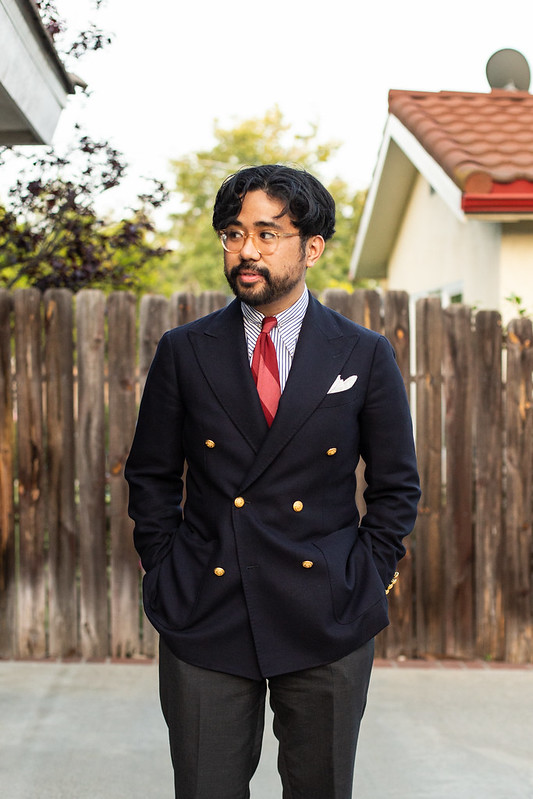


All this talk of the journeys we’ve undertaken to obtain our clothes reminds me of the story of how I acquired one of my favorite and most-worn garments in my closet. The funny thing is that, unlike the others, this one didn’t involve much work or effort— just dumb luck and fate. I’ll close out with this one.
For a long time, the only Blazer I owned was a vintage sack that I found at a random thrift store in Orange County. It served me well, but I knew that I wanted a DB version because, well, I love double-breasted closure. Such jackets simply provide more 30s attitude, as well as feel very Ralph. eBay didn’t yield anything in my size. And back in 2019, Spier & Mackay hadn’t made their version yet, and MTM places like Collaro and Natalino didn’t exist or just weren’t on my radar.
Fate aligned darkly when The Bloke, the only classic menswear atelier in Los Angeles, announced in 2020 that it was closing down. They would be having a crazy sale to liquidate their inventory, which included their stock of Ring Jacket. And wouldn’t you know it, they had a DB blazer, all made up in “Balloon”, their proprietary openweave cloth. Not only that, but it looked the way I wanted: broad shoulders, wide, horizontal peak lapels, and wide-set buttons. I was able to nab it for around $650 or so, which was around 60-70% off. What an incredible deal– and what a way for me to get my first navy DB blazer!
The rest is history. You guys have seen the Navy DB blazer become quite the foundational garment in my wardrobe. I wear the damn thing so much! It’s as iconic to me as a brown plaid jacket or a reverse stripe point collar. Naturally, it went with everything: grey flannels, flared jeans, foulard and repp ties, Breton stripe tees, open collar shirts, you name it. But then the unfortunate happened– I started to outgrow it.


Call it getting older, call it the gym, but with all the pinching in the shoulders and armpit, it started to feel rough to wear, especially as someone who preaches the drama of drape and slouch. I never like parting with garments simply because I put in so much effort in acquiring them, but at a certain point, it was time. It had been a nice few years, and it was time for MJ (who is a size smaller than me) to enjoy all that Ring Jacket had to offer; he even got my beloved wool-silk-linen houndstooth jacket, which was the same size as the Blazer.
I obviously wasn’t going to continue living life without a DB blazer. As I said, the thing is foundational! But where would I get it? Spier was a bit promising, but I wasn’t sure about sizing, especially as I also outgrew my old 38Rs (which I bought pre-pandemic); I also was now too used to the Ring Jacket make. The sale price even made MTM feel too expensive. Perhaps I could finally luck into a vintage RL one (spoiler alert, I never did).
I actually did end up with a vintage one, a late 60s number with bellied lapels and a lightly padded shoulder, courtesy of a random visit to American Rag CIE. It was nice, but it was a different attitude compared to the RJ one, which felt more aligned with a “soft and modern approach to Apparel Arts”. In other words, the old Ring Jacket was more “Ethan”. Little did I know that it was my destiny to return to it.


My buddy Doug also bought a few Ring Jacket sportcoats from The Bloke’s clearance sale. Among his purchases were two WSL jackets… and the Navy DB Blazer, all in the next size up. And as fate would have it, he was selling his little RJ collection. I can’t recall why, but it didn’t matter. I wanted to be reunited with my beloved Blazer (as well as the damn brown houndstooth). I got them for slightly less than what I paid for (as they were lightly worn and already altered), but that was perfectly fine; considering the retail price of RJ, this was a robbery. After a quick alteration and button replacement (he converted it to a 4×2 with his own flat brass buttons), Blazer Ethan was back in business. Apart from that short interlude, it was almost like he had never left.
I guess sometimes it’s not about work, effort, or intention. Sometimes it really is just fate…and dumb luck.
At least it wasn’t passive!
– end of blog post –

After all, when I wanted black flared jeans, I looked everywhere; no dice. In the end, I found the same style of jeans as my dungarees and then dyed them black myself. Getting good clothes, especially with a specific taste, will always require effort!
Thanks for reading! Don’t forget that you can support me (or the podcast) on Patreon to get some extra content and access to our exclusive Discord.
Always a pleasure,
Ethan
Big thank you to our top-tier Patrons (the SaDCast Fanatics), Philip, Shane, Henrik, and Mason.


One comment