
This is a recap-ish of the latest podcast episode. You can listen to the episode below before or after you read. That’s because I tend to expand on topics from the pod as well as straight-up write about things that we did not discuss. The choice is yours in how you want to proceed!
Hello, my friends!
Writing this blog post has been quite an interesting experience. Granted, most, if not all, blog posts take a lot out of me, but this one in particular had me feeling odd a few times. Perhaps that’s because I’ve been going through it. Nothing awful, mind you, but just the typical “I’m in my 30s now”-melange that combines the best and worst of sentimentalism, nostalgia, and existentialism. There’s also a sense of finality covering it all. It’s been happening ever since I turned thirty (or maybe even before then), but I guess there are a few things that have happened lately that have just bolstered those emotions.
And the first one is a big one, a truly existential situation that menswear guys dread to see: my tailor has retired.
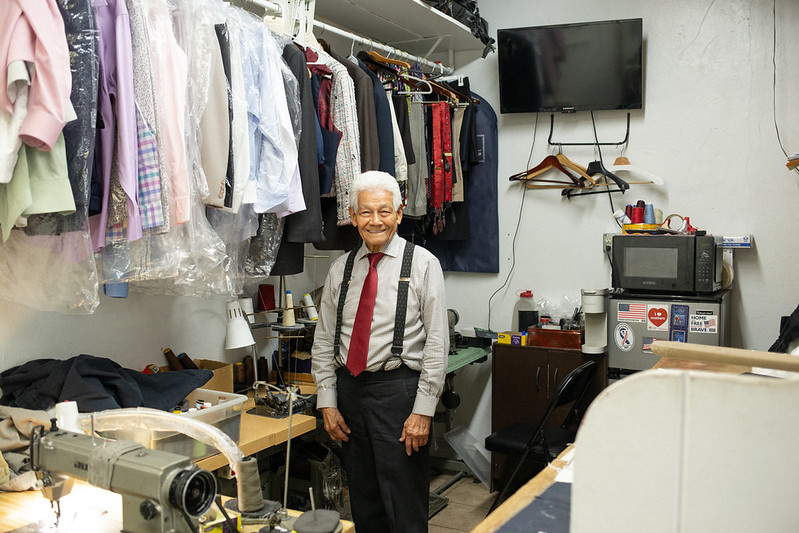
Noe Montoya of Academy Tailor Shop has been (I’m sorry, was my tailor) for the better part of a decade. This man has worked on damn near every garment in my wardrobe, whether it was sleeve hems, taking out/letting in trouser waists (hopefully more of the latter), the occasional patch and collar flip (only works if there isn’t a slot for a collar stay on the other side), as well as the handful of crazy experiments that I wouldn’t really recommend people to try (like Shoulder Surgery)— unless they really trusted their tailor. And that’s the thing; I trusted Noe completely. The man lives and breathes menswear.
I started going to him back in 2016/2017 when I was finishing up university and ready to come back to Los Angeles proper. At the time, I was going to two different tailors: Mr. Tran in Riverside and Ruben in Orange County, the latter of whom is still working on clothes! My bar was quite high, because both of those tailors had years of experience making suits before they shifted to alterations only (SoCal doesn’t have much need for hand-tailored custom suits, at least from independent makers in, well, smaller population areas). Their sartorial experience made working with them quite easy, as they understood exactly what I was going for, at least for that version of Ethan.
That connection was extremely important to me, which is why I considered making the trek every time I needed something done. Thankfully, I never had to, thanks to Noe, who Mark C (a niche-famous vintage menswear collector-historian) and fellow Pasadena local and milliner extraordinaire Cody Wellema recommended to me all those years ago. They told me that Noe had decades of experience making full-on suits and had even kept it going a few times in recent years. I was intrigued and excited to thankfully have someone I could trust to work on my clothes, both in terms of vintage and my growing contemporary-classic menswear collection. I was even more delighted to learn that Noe’s shop was less than 15 minutes away from my parents’ house, which meant that I was there at least once a week, getting something done or picking something up.

I loved seeing Noe, whether it was just for a quick pick-up/drop-off or a longer conversation while he fixed something up (a split seam). He always insisted I wait, since it let us catch up! For me, it allowed me to remark on his outfit, which was always incredibly well coordinated.
The man was always dressed up. There was never a day I saw him when he wasn’t wearing a proper dress shirt, pleated trousers, oxfords, a tie, and, most notably, a pair of vintage Trafalgar braces, particularly the Calvin Curtis “Silver Dollar” motif ones. Wearing a tie is never mandatory for a tailor, but I liked that Noe did it anyway. In fact, this idea of dressing for fun was something that we bonded over, as I was always in some bold sartorial ensemble whenever I came by. We’d take turns complimenting each other and sharing the nerdy details about our garms.
It wasn’t just that Noe had decades of experience making bespoke suits (he moved to New York from Honduras after getting married in 1963 and settled at his current shop in the 80s); it was that he had a deep appreciation of classic tailoring. His use of pleated trousers and suspenders was my first hint, but the biggest indicators came in the decor of his shop. Framed on the walls were DIY printouts of Apparel Arts illustrations, mimicking my own inspo folders. There are even photos of existing clients dressed in their vintage-best, with one in particular wearing novelty 1920s-style trousers (high-rise, straight leg, with wide tunnel loops) that Noe made himself from a bolt of vintage cream flannel. The coolest item was a tailoring system book from the early 1920s, which showed instructions and patterns for all manner of sartorial pieces— all in Spanish.
This guy knew what he was doing and could literally do it all. If asked, he could make/alter something to be tapered and “modern” (by 2010s) standards, but he also understood the importance of a classic silhouette—as well as the differences between eras of menswear. During one visit, Noe showed me his wedding suit: a trim continental-style number in a shiny blue mohair. Later on, he made sure to bring out his own collection of 70s jackets and 90s trousers, the ones that he didn’t make being his own old purchases, both new (at the time) and second-hand (he loves thrifting). The best part was when he made sure to show some of the fun things that other clients had brought in, whether it was a 1920s Norfolk or a Ring Jacket ditty from The Armoury (I always made sure to plug Noe whenever people asked for an LA reco).


In a way, seeing Noe each week (Saturday mornings or Tuesday nights, before trivia, of course) was my ritual. It felt weird not to see him, especially because it was quite rare for me not to have something that needed work.
This made more sense at the beginning of our relationship, as, like any menswear guy worth his salt, I was constantly buying things, new and old. After all, a good tailor means anything is a “potential.” Shirt fits the neck, but it’s a bit too big in the body and sleeve? Off to Noe! Found the perfect pleated shorts on the cheap, but they happen to be just a tad too small? Noe’s got it covered, as long as there’s enough in the allowance (which is why you should always ask for photos on eBay). A steady stream of hems and lengthenings done by guy Noe is one of the main reasons why my wardrobe is as large as it is!
As I got older, those thrift-vintage purchases slowed down. I became more intentional with my buying and began trading thrifts for contemporary RTW and the handful of custom suits from Atelier Fugue and Suit Supply. At one point, Noe even remarked that my latest projects all had unfinished sleeves, referring to the jackets from Spier and, later, Ring, which became my odd jacket arsenal. Through it all, Noe made sure to explain what would change and how, which only deepened my understanding of tailoring systems; this was especially helpful when he worked on my custom orders, which always needed a tweak or so, particularly for the trouser drape. I am certain that my relative success with accessible MTM is in no small part due to Mr. Montoya.
Near the end, my visits to Noe became less about getting new acquisitions ready for wearing and more about maintaining my wardrobe. Body tapers were replaced by collar flips, and sleeve hems became elbow patches. Of course, I still undertook a few major alterations, mainly in trousers, like reshaping thighs or adjusting the back rise (by lowering the rear part of the waistband), all done because I had simply learned more about how everything “sat” on me. It’s all because I didn’t want to buy new pieces every time, but rather work with what I already had. Noe actually recognized many of these pieces over the years, commenting that they were always good, but just needed a little adjustment. He would often compare them to his own clothes, which he also repaired constantly as time went on; I definitely noticed the quick little fixes done for the occasional snag or moth hole.
Outside of a few rush pieces (like fixing a tux shirt ahead of the Phil or letting out a cotton suit before Spring/Summer), I never asked for a specific due date. It’s not like I wouldn’t have anything to wear! Nevertheless, Noe would always try to turn it around in about a week; after all, I always found myself at his shop every few days. If it wasn’t ready or if he simply had too many customers that week, it was perfectly fine. I’d see him soon anyway!
>
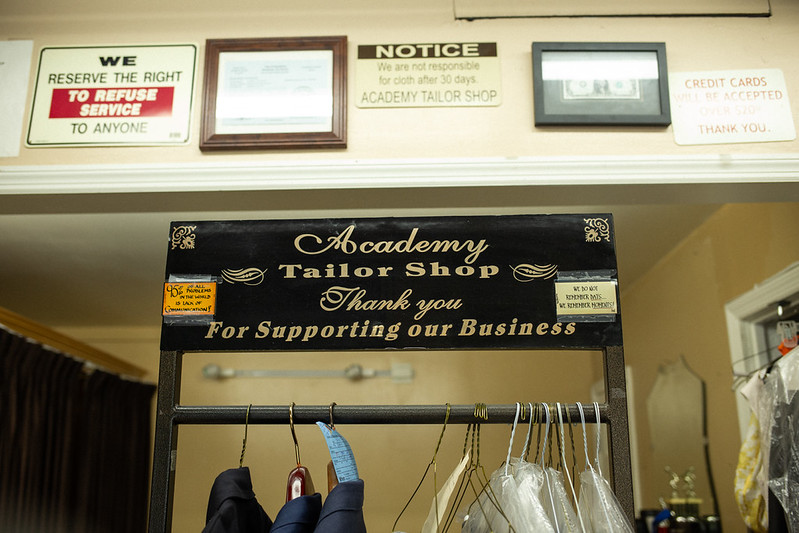

Noe Montoya has always been a kindred spirit, and I am terribly sad to see him retire. It also goes without saying that I am so happy for him to finally take some time off after all these years! It’s no small feat running your own business, let alone one that requires you to physically be in the store and work on your product. Tailoring, alterations— it’s all a trade, and Noe certainly was a master tradesman, in addition to being a perfect gentleman and good friend. I certainly regret not taking a proper portrait of him each time I visited, but I’m glad I got the snaps I did. I’ll definitely miss my weekly chats with Noe, with his vibrant smile and firm handshake there to greet me each time I rang his bell. But hey, just like me, maybe he can now focus on having fun in his clothes, instead of working on them.
Unfortunately, I don’t have a new tailor just yet, but I’m honestly not in any hurry. That’s mainly because I haven’t even had anything altered yet, as new purchases have been halted. My current wardrobe fits me perfectly, thanks to Mr. Montoya. You might even say that his spirit (which is alive, mind you) is literally woven into all of my clothes. Though I do fear the next time something needs to be repaired…in which case, please let me know if you have any recommendations for alterationists in the LA area.
I could always use a new friend!

Next up is something quite silly and nostalgic, despite, well, never doing the exact activity before in my life. I’m talking about a visit to Avalon, on Catalina Island.
Some of you may be surprised to learn that I’ve never been to Catalina. I had always heard how fun it is, being a beach town full of restaurants, hotels, and watersports, that’s only an hour-ish ferry ride from Long Beach (or San Pedro). But, much like the beach itself, I’ve just never had the time to go. Hell, I’ve been to the beach more times this year (twice) than I have in the past five years; it’s just hard to find the energy to go, let alone get people to come with.
Catalina is also a historic place that vintage people love to visit. While the island had its first attempts at development in the 1800s-early 1900s, it wasn’t until Wrigley’s ownership that it became the local-tourist destination we’ve come to know it as today. A slurry of buildings, including the iconic Casino, were all made in the beautiful Deco Style, and with the various restaurants and hotels, the island soon became a home away from home for Golden Era celebs and socialites. The LA Art Deco Society strives to keep that vibe alive with their annual ball, which boasts scores of vintage-dressed visitors each year, all of whom are ready to dance on the Casino’s massive dance floor. Spencer and I have never been one to swing dance, so despite having a few acquaintances back in the day regularly attend the Ball (it is quite the shindig, I’ve been told), I’ve just simply had no real reason to visit the island.
That is until, of course, my girlfriend told me that she had actually been to Catalina before and had a great time. No, it wasn’t for anything vintage or swing dance-related, but rather just to enjoy the scenery (she apparently painted a bit while she was there). And so it was decided: I would finally go and see what Catalina was all about.
And I was also excited to finally dress for it.

One might have assumed that my trusty white (it’s actually more of a cream) suit would have been the move for a day in Catalina. After all, a garment just makes sense for this particular Occasion, as a white suit is the epitome of summer sartorial style—especially when vintage style is concerned. But perhaps that move would be too obvious.
To be clear, there’s nothing wrong with playing a menswear trope straight, but sometimes I like the challenge of doing something different, mainly to exercise other potential combinations. There’s also the fact that I have indeed been wearing my white suit pretty damn often, even when I’m not doing a decidedly summer-themed activity (like having coffee by myself and walking around an antique mall). While others may see a white suit as a “special” garment (I’ve done it too), I’ve really made strides in making it, well, “just a suit I wear when it’s warm”, not unlike wearing a dusty cord suit in autumn. So, while a white suit may have been what most people would wear to Catalina (well, if they wanted to wear a suit, that is), I decided to go for something a bit more interesting by opting for separates instead and fully sending up the Art Deco spirit. Hey, if I wasn’t going to attend the Ball, I could at least dress like I was!
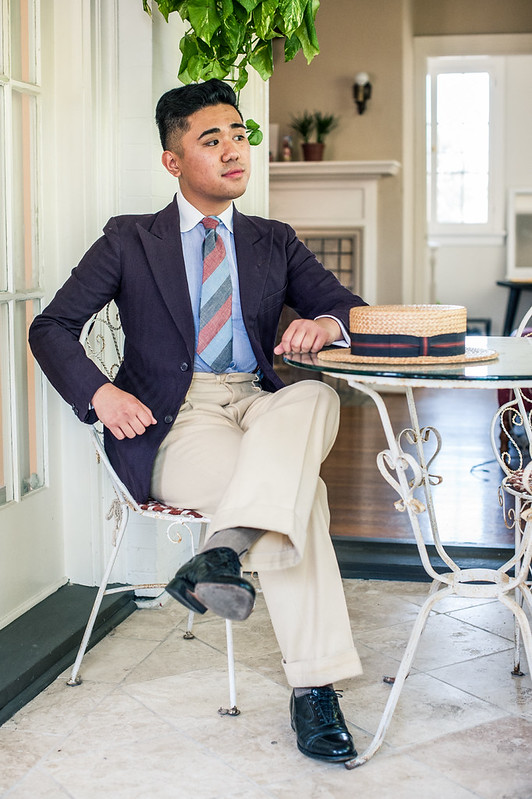
The final fit was a very dandy look that may just be the most 20s/30s pointed ensemble I’ve ever done, at least not since I was actually a teenager. My cream suit was represented through my odd trousers, but for my jacket-slot, I decided to go a bit nautical (and sporty) by wearing my DB navy blazer. I seldom do the blazer + white/cream pants (or khakis), as I tend to go for more trad combos (with grey or dark brown trews), but this was the perfect situation for it. This move for separates is historically more casual than a full suit, though it is a lot bolder, primarily because of the contrast and, well, the shiny brass buttons dangling from the blazer’s chest.
Of course, the real Deco moves came in my accessories. White bucks, the perfect summer shoe that isn’t a fisherman sandal, were prepped even before the full outfit was made. I also knew that I was going to wear my round (but narrow) 30s-style sunnies, a playful item that I haven’t really worn since I was a teen. They are very “Gatsby”, which, if you consider how formative the 2013 film was for my style, simply made sense for my Catalina day.
For neckwear, my favorite early-30s brocade tie, a purple, abstract-stripe ditty, was chosen, adding an elegant air against a typical blue-stripe shirt and the trad blazer. I tend to wear stripes with navy blazers (IMO, foulards and geometrics look better against plaids and solids) but a regular ‘ol repp or block didn’t feel special— or Deco— enough for this fun day. That tie’s deep purple hue really does elevate this jaunty look. Funnily enough, it also reminded me of that last white-suit look, when I wore a purple polka-dot tie, though the look was more RL Purple Label fashion than 20s Catalina. It can be nice to let myself be taken by a decidedly vintage attitude.

Speaking of being vintage and jaunty, the real Deco-making star of the fit was my use of the Straw Boater. It’s a silly little hat, one I only pull out on truly rare occasions because even I feel intimidated by its bold presence; I tend to wear a cotton beret or my Panama when I feel the inkling to incorporate some warm-weather headwear. Of course, I bought the damn thing for a reason, and what better place than Catalina to wear it—especially since I was already wearing a boater-friendly fit. Come on, white pants and an odd jacket in summer just scream “boater”, doesn’t it?
I’m still not certain that a boater needs a full blog post, but I do want to spend a bit of time on how much I love this thing. Just as a beret or Tyrolean brings a sporty, autumnal euro flavor to an outfit, the boater brings an antiquarian, warm-weather attitude to an outfit. That hat is the definition of whimsy, being so delightfully antiquarian that it’s hard not to smile when you see one— or when its on your head. And despite its rigid fabric and appearance (compared to a soft fedora or western hat), a boater is infinitely more casual, adding an air of fun to any sartorial outfit; I especially enjoy seeing it with dark suits or with black tie (which I still have yet to do). It does look great without a jacket or neckwear (I’ve done that before), evoking more of a “gardener” or “old man on a stroll” effect, but nothing compares to pairing it with a Full Sartorial Outfit, where the whole point is to be dandy.
That was certainly the aim of my Catalina outfit, so on the boater went on my noggin, the final piece that firmly put my fit in the Art Deco-inspired camp. It also helps that my particular boater is a softer straw and isn’t as stiff as true vintage ones. It’s more “cottage core” than Gatsby, but hey, that’s fine by me! Wearing it with the brocade, white pants, and bucks made the whole ensemble even more special and pointed toward the vibe. Even though I’m not much into the vintage scene these days, it felt fun to feel a bit connected to that world with my attire.


I can’t lie. I did feel like the outfit was a bit too out of place. Catalina is indeed a beautiful place that certainly calls for a fun, expressive outfit, but it’s definitely meant more for activities. You know, like watersports or gleefully (and responsibly) consuming cheeky libations. In other words, I should have come to the island in a vibrant rayon aloha and swimming trunks—and not instead of wool trousers and a delicate silk cravat. It’s my fault for not researching the town and being a bit more intentional with planning!
Right as we docked, our fellow passengers spilled out of the ferry and immediately sought to claim a space on the beach. Even at 10 AM, the streets were filled with people who had clearly been enjoying the ample sun— and carefully avoiding the still-active LA policy on open containers. Don’t get me wrong; the place looked like fun! All the themed restaurants boasting fresh seafood (we ate Mahi-Mahi) and tropical-themed bars (one bar gave out beachcomber hats with a certain drink) seemed fantastic. Even the curio shops seemed a bit charming, even if I wasn’t exactly into buying wind-up divers, shell picture frames, or a Tommy Bahama-esque shirt; I did walk out with a vintage-themed sticker, which I promptly put on my Rimowa case when I arrived back home. Overall, I wish we’d come with a bunch of friends ready to eat, drink, and swim, or at least around a specific event (maybe not the Avalon ball, since I don’t dance, but it seems like Catalina has annual festivals for jazz and arts!). But that didn’t mean our day was a bust! Far from it, in fact.
My girlfriend and I did as much, well, “Ethan activities” as we could, walking around the town and noting the different architecture. After lunch, we sauntered over to the Catalina Museum for Art & History, where we saw a very informative and silly (due to the 30s newsreel-style aesthetic) video about how Catalina was formed. I had no idea that William Wrigley Jr. had such a big part in this island’s development! [He was also quite the stylish dresser.] The museum also had tidbits on the island’s frequent use by Golden Era Hollywood stars, military and sports teams (for training), and its native history. There was also the art part, with a wonderful cyanotype exhibit and a feature on linoleum block prints created by an art professor from my Alma Mater. I never took an art class when I was there, but it was fun to have that little connection.
The best part of the day was obviously getting to visit the Avalon Casino, which sits at the corner of town (next to the Descano Beach Club) in all of its Art Deco glory. As I said earlier, I am not much of a dancer, so I never expected to have a reason to step into that place, but I’m glad I did. The entire building is a masterpiece, both in its scale and in the various Art Deco mosaics and murals displayed on its interior and exterior walls. We made sure to take a moment to sit in the theater so that we could properly take in the iconic Beckman murals, all while watching Buster Keaton in The Boat and the Gopher Spinach Popeye short. [I later bought a print of the horse-section of the mural.]
Of course, the best part was the massive Avalon ballroom, which, when not being flooded by vintage enthusiasts showing off spectator dance moves (the videos are wonderful), functions as a local roller rink. It was pretty quiet that Sunday afternoon and would have been a bit creepy if it wasn’t for the charming, retirement home-esque quality the place had. A mix of oldies and 2010s-ies was playing on the speaker (which, again, is likely best served by a live swing band) to set a tempo for a handful of skaters, while couples played giant versions of Connect Four and Jenga on the tables surrounding the enormous, uninterrupted dance floor. My girlfriend and I enjoyed a Dr. Pepper from the food stand before stepping out to the rotunda-terrace to enjoy the truly spectacular view of the beach— and take a few portraits.
No cocktails were had that day (the Descanso Beach Club closed early for a wedding), but it was a good outing nonetheless. I’m just glad I got a bit of Deco in so that my outfit made sense!

Reflecting on that day, I am certain that I had a funny feeling when I wore that bold, 20s/30s ensemble, apart, of course, from being definitely overdressed for the day. Yes, the cream pants-boater fit is quite a bit extra compared to what I wear on a “normal” day, but it also feels nostalgic, as it has a lot in common with the vintage-inspired looks I wore when I was first starting out.
Before I firmly fell in love with fedoras, soft-squares, and all things 30s-40s, I styled myself after the 20s/30s. I was indeed a bit more dandy, doing my best to evoke an old look through mall-brand suits, thrifted ties, and the occasional True Vintage splurge. I even had a small collection of boaters, which, for a time, I wore much more often than fedoras, simply because they made me look (and feel) a bit more vintage. If this old AOS interview is any indication, I leveraged the 20s/30s aesthetic whenever I wanted to be a bit more elegant and dandy; Apparel Arts (and general midcentury stuff) was always meant to be my base look.
And so in a way, this silly little Catalina look was my way of honoring that part of my fashion journey. I obviously own items from that era, but it’s clear that I don’t style myself after that POV very much. I can’t say that I’ll continue pulling from this facet of my Taste, but at the very least, it’s been good to know that I can be a bit more anachronistic and dandy— and that I still love straw boaters because they’re awesome and completely wearable today. Maybe in the end, all it takes for me to have camaraderie with an outfit or style is to have an Occasion do it. I certainly did: a fun day trip with my partner…even if there really isn’t much to do in Catalina on a Sunday night and the ferry back to Long Beach is fully booked, so you have to sit in different parts of the boat, trying to fall asleep so as to avoid getting seasick from choppy water.
If I come back to this island, I will definitely be wearing an aloha shirt—and a beachcomber— to finally sit on the beach and drink a damn Buffalo Milk cocktail.

That whole breakdown of a breakdown of my outfit, and the aforementioned melancholy from my tailor’s retirement, leads me to your favorite part of any blog post: Ethan’s philosophical ruminations! Could this be the final one— the one that strives to encapsulate everything he feels about menswear? Honestly, yeah, maybe!
As you know, I’ve spent the better part of a decade trying to define (or explain) just how I view Personal Style— emphasis on the term Personal, as it’s clear that most people do not think about clothing in the way that I do. Despite that narcissistic focus, my goal was altruistic: to uncover a common approach or a unified (but general) mindset that, once we were aware of it, would help us not only make better purchases but also create outfits that express who we are. In other words, the more we know what Personal Style “is”, the more cognizant we are of our Taste and Expression. Plenty of other influencers have said their piece on the topic, but if I’m being honest, I’ve found most of their statements a bit too intellectual (or introspectively) shallow; it’s always about some form of Authenticity, to be “true” to yourself, whatever that means. It’s not untrue, but it’s not exactly helpful if we’re actually trying to understand our creative output.
One issue I’ve had with such discussions is that they’re really predicated on the clothing part of it. Granted, menswear is a consumptionist hobby, but I’ve never been satisfied with that excuse. Again, my mission with this blog has been to make this absurd hobby a bit more real, something grounded in how we approach the world rather than simply recommending an article of clothing. Not all menswear content has to be about consumption; it can be about the wearing part, too! The funny thing is that my understanding of the “wearing” part—what I view as the actual creative part of fashion—has come not from conversations about clothing, but from other creative avenues, namely music.
Such introspective discussions always yield fruit, particularly my framing of Personal Style as the toolbox of techniques one uses to achieve a specific expressive goal. We all have some form of this, where certain elements (objects or actions) simply feel like something or call an emotion or reference to mind. It’s all based on how we engage with the world and form relationships between actions and ideas. While this cognitive mapping may not be wholly original (is it Nature or Nurture that minor chords “feel” sad, or that a necktie is formal?), it is indeed personal because we still form those relationships through our own experiences. The Style part comes in how consistently we leverage said relationships as we create our art-objects. It’s pretty much about being cognizant of our expressive shorthands!
You can find this all over music, from reliance on certain intervals to the use of a particular orchestration. A composer could use a major 5th to evoke heroism or a lyrical 6th for something romantic. Perhaps the oboe’s nasal timbre works best for a lamentful melody, instead of relying on a stereotypical fiddle or solo piano. A predilection for harmonizing a bouncy march as 7ths with layered horns and strings creates a stately sound, one that might show you that your voice descends from the English tradition (à la Walton) rather than the more brutal sounds of Eastern European composers. Maybe, when it comes to writing something sinister, you forgo blocky minor chords in favor of the slinky chromatic turn for something sinister. It could even be about favoring a type of Form where, when presenting a main theme, you like to add a little “call and response, to break up treatments of your main theme. Unlike the other techniques, this move doesn’t necessarily mean anything emotionally, but it does say something about how you like to present yourself, especially if you do it as much as John Williams does.
It goes without saying that you also can find similar approaches across all manner of creative outlets, especially menswear. Most of it is based on historical precedent, such as using black to evoke something formal, chic, or sexy. But after a certain point, we develop our own shorthands, or at least the ones we find ourselves favoring most (I tend to prefer this over simply doing everything, which feels exhausting). If I want to be dressy but whimsical, I’ll do something more 30s/Apparel Arts, complete with collar bar and braces. When the goal is to play up formality, I’ll opt for an elegant brocade with an abstract design over a printed foulard. If I want to wear tailoring and a tie but be more “approachable” or casual, then ivy elements are the move: a repp is fun but less whimsical than “soft squares,” and a rumpled OCBD has more ease than a pinned point collar. Similar expressive shorthands come into play when it comes to dressing down, too. Will I be casual through westernwear or workwear? Or will I go for something more shapeless and dramatic? In short, Personal Style is all about how we express ourselves, guided by the internal POV that tells us which shorthand to use.
Now I’ve been pretty satisfied with this “toolbox definition” of Personal Style, as it really highlights the importance of POV and ultimately, being cognizant of your relationship with expression and the world in how we undertake, well, any creative endeavor. But a part of me always felt like something was missing, something that went even deeper into POV and perhaps revealed why our output looks the way it does. Not in terms of genre, but in terms of the template that our creative efforts are organized in, all in pursuit of the final form that they ultimately take.

This approach to using the Form/Template concept (they’re really just interchangeable) as it relates to Personal Style came to me during a recent discussion with Patreon Russell in the SaD Discord about, you guessed it, music.
In said Discord, which is mostly about discussing all things menswear, I found myself venting about my latest creative project, namely my efforts to compose the music for the upcoming sequel-party to Cosmus— you know, the elaborate wizard-school themed shindig that my pal James cooked up. Even though the final product will function more as a stand-alone soundtrack (“From the World of Cosmus”, as it were) than a legitimate, functional score, mainly because it will be damn near impossible to sync the music with the actions and speeches we’re planning for the party (yes, there is a plot in this next one), it has still been quite the endeavor to complete. Some of it is indeed because I want the melodies to be hummable (discernible) and natural, where the intervals—the “spaces” between the notes— feel like they’ve always been there. No, that part is obvious. The part that wasn’t as clear to me was that my idea of a finished work had a specific type of presentation, one that required a bit more than just, well, having a melody on hand.
Anyway, when I was discussing the theme I was writing for Cosmus’s ghost, Russell asked me if I would ever consider doing something in the vein of Ludwig Göransson. He’s the composer who’s become widely celebrated for his minimalist, almost ambient-esque scores for Oppenheimer and The Odyssey. I am not wholly against Göransson, but his approach, his presentation of what a finished piece is, is just not me.
Whether I’m composing or, hell, when I think of the general concept of a stand-alone composition (not a cue for a specific scene), my mind simply doesn’t go to a short melody that is stripped down and played by a pair of instruments. Instead, my concept of a piece is predicated on the symphonic concert suite, as it provides the space (breathing room) for a theme to be explored both as an exercise for a full orchestra and in terms of its melodic contour. Hell, there’s seldom just one melody. A regular composition of mine makes room for “B” and even “C”, as, after all, people can contain multitudes, and when it comes to writing, it makes sense to give a subject as much musical identity as possible. I mean, once I get in the groove, musical ideas, much like outfits, tend to come pouring out, and having a concert suite with a proper intro, bridge, and coda (and ABACA, or os, as a format) lets me house— and honor— all of those ideas in one place.
I am not sure exactly why I need to put my non-cue ideas in this form; my work would be much less stressful if this weren’t the case. I’m sure much of it comes from my appreciation of classical music, where the whole genre is about presenting musical ideas in a particular format (though the specifics have indeed changed over the centuries). Maybe there’s something related to my love of essays, where written concepts are, like symphonies or concertos, also laid out in a particular structure that takes you through the writer’s ideas. Perhaps it’s because I want my music to feel like something you can conduct or perform (it’s not just about listening!), which is easier when the work is arranged that way from the get-go.
[There’s also the fact that John Williams always arranges his themes for the concert hall. Anakin and Padme’s ill-fated romance is represented in the AOTC score by a mediveal-esque triplet melody (1:04), but it gets a fleshed-out treatment in the soundtrack. Tintin’s loyal pal Snowy has a short motif that gets a whimsically complex presentation, complete with an insane piano cadenza. Williams’s Olympic Fanfare can function as a news bumper, but its full presentation is a four-and-a-half-minute musical story that evokes a race. It’s more than just choosing a medium or genre (orchestral music). It’s clear that Williams has an internalized idea of what a finished work is, being the holistic presentation of his themes or musical idea. Every composition, at least for concert audiences, follows that Template and ultimately takes that Form. Are you following me?]
But despite all the fuss that comes with my need to present my work as such, I actually enjoy it. Why? Because, well, it’s who I am! In addition to perhaps my love of particular intervals or orchestration, this dedication to the concert suite is a part of my Personal Style. It reveals how I think about music in general; it’s not just about making a melody, but about presenting it holistically. In fact, you might even say that knowing the form the goal will take has an effect on the creative process. Maybe the reason why I make “B” and “C” themes, as well as make room for filigree and “call and response” tactics, is because I know that the concert suite is what I’m aiming for at the end of my Logic timeline.
And that’s when it hit me. The concepts of Form and Template explain why we use consistent, discernible techniques that comprise our Personal Style—while also being a defining facet of our Personal Style to begin with.


Thankfully, these terms aren’t exactly too high-concept or esoteric. In fact, I can get right into a menswear example!
Our entire goal when getting dressed, outside of “not being naked”, is making an Outfit. The Personal Style part is meant to come, well, in styling said outfit. Seems simple enough, right? Well, that’s what I used to think until very recently. You see, I’d argue that Personal Style—or, at the earliest opportunity to leverage POV and your internal expressive-mapping—actually comes before the act of styling. It arises when you’ve decided what an Outfit even “is”.
You see, to me, an Outfit is not simply the combination of clothes that happen to be on my body. No, my definition is much more specific. And when you look at my archive of fits over the years, the rubric is quite obvious. An Outfit (à la Ethan) is [almost always] a combination of jacket, trousers, shoes, button-up shirt, and, in most cases, a form of neckwear as well; there may even be a hat to cap it all off. It’s an ensemble, a cast of pieces working together to make a “whole”; each piece is important and almost always necessary.
There is a Form here, a template or rubric that I adhere to. Parts of it are based on anachronistic fashion ideals and some vague idea of uniform dressing, but it’s also because I believe this particular Form is the best way to let my outfit-object be a holistic menagerie of geometries and silhouettes, all working in harmony. I’ve spoken a lot about how the intersecting lines that emanate from collars, lapels, and neckwear are quite delightful to me, and so it makes sense that I tend to dress in a way that honors that effect. It just feels right!
Obviously, this is why I am often found in sartorially inclined ensembles. Five days a week, I do indeed wear a jacket, tie, trousers, and leather shoes, with the exact holistic expression stemming from the genre I’ve decided to go after that day. If the POV is Ivy, then that means the shirt will be an OCBD, the jacket is either a blazer or a glen check, the tie will be a repp (or maybe a solid knit?), the socks will indeed be white, the shoes will be penny loafers, and the hat will either be a bucket or something forgone entirely. There’s still some nuance to be had, such as the trouser decision: mid-grey slacks, straight-leg jeans (or flares for a 70s spin), or classic military khakis. I could also skip the separates discussion and opt for a suit, which easily covers the jacket-pant decision.
You might be thinking that this is just what a sartorial outfit “is”, so it’s natural to be a bit maximalist, especially if my own taste is predicated on wearing a tie. But here’s the rub: I use this template even when I’m not being sartorial.


Just think about it. When I’m casual, which is usually some form of Americana/milsurp/workwear, my outfits tend to still adhere to that Outfit Template.
The shirt can still be a button-up, like a workshirt or loop collar, but it could also be a tee. Pants can be fatigues or gauchos, maybe even shorts. Shoes could still be loafers, or they could be fisherman sandals, deck shoes, or Mary Janes. There’s nothing wrong with going sans-outerwear, but I tend to have something on top of it all, whether it’s a chore coat or a leather jacket. And, more often than not, there’s usually something jaunty around my neck (a scarf or bandana) and, when I really feel it, a hat perched on my noggin. Dressing down may not exactly look like a suit, tie, and fedora, but I do think a lot of the same slots are being used.
Yes, sometimes I may intentionally forgo an item or two in the name of comfort or subversion. I can perfectly leave a beret or fedora at home, or let my shirt remain severely unbuttoned, untrussed by a silk cravat. I am not a purist about my own Template.
However, the older I get, and the more self-reflective I’ve become, the less this is the case. I’ve just been more consistent about staying true to my template. For example, I don’t think that a jacket is always necessary, but I do find myself wearing some sort of outer layer. It’s just that their inclusion feels right, “authentic,” not in terms of the outfit-genre, but to the very idea of what an Outfit means to me. And hey, if we want to get even more abstract, perhaps a severely unbuttoned shirt— or rather, my open chest— in some way, still counts as “neckwear” (or chest accessory). There’s something at play there, something that fulfills my adherence to Form.
I don’t think this is a matter of being a maximalist, but simply that my definition of “Outfit” just tends to be predicated on wearing most, if not all, of those previously listed pieces. In other words, my Personal Style not only shows up in the techniques I use to fill the template, but also in the very basic idea of what I consider the template to begin with!


To be clear, this whole discussion isn’t even about genre or cinematic dressing, the latter being the method of using character- or narrative-based styling decisions. They are important, but the more I think about it, the more I realize that my use of them still stems from my basal Outfit Template. It doesn’t matter if I’ve decided to be a cowboy or an Ivy Leaguer, an Apparel Arts illustration or Safincore, or hell, whether I want to be Formal or Casual. In fact, the fun challenge is how I can express those nuances while still staying true to my Outfit Template. Maybe that’s why everything I wear is all Vaguely Menswear, even when some stalwarts may think otherwise.
On that note, it’s also obvious that many outfits within the realm of men’s fashion follow that same Form. But I also think most people have a much less extensive idea of what an “Outfit” is; by which I mean they typically stop at just a shirt and pants. Jackets, neckwear, jewelery- these are all superfluous accessories, added when they feel like they’re being extra. Their idea of an Outfit’s Form simply has fewer slots. That’s perfectly fine and only helps define their Personal Style!
I’m just the opposite: each of my slots is “required”, more or less. For me, my Form will always be a combination of jacket, shirt, pants (well, bottoms), shoes (usually leather), and likely neckwear and maybe a hat. Doesn’t matter if it’s formal or casual; I tend to always follow this Template. That’s just my Personal Style! It may sound rigid, but I find it incredibly o freeing. You guys are plenty aware of how often I get to mix and match from the menagerie that is my closet to make something work and ultimately create an outfit I’ve never worn before. It’s not a uniform per se, but it is consistent.
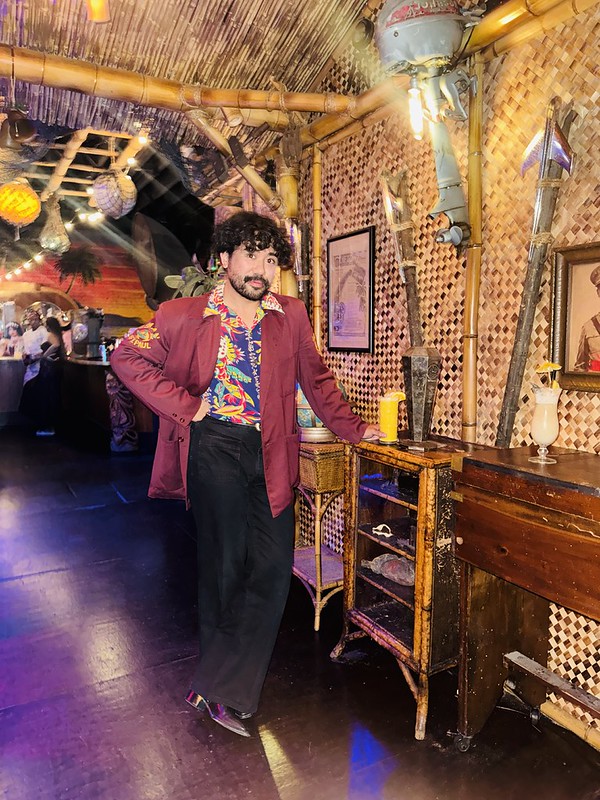
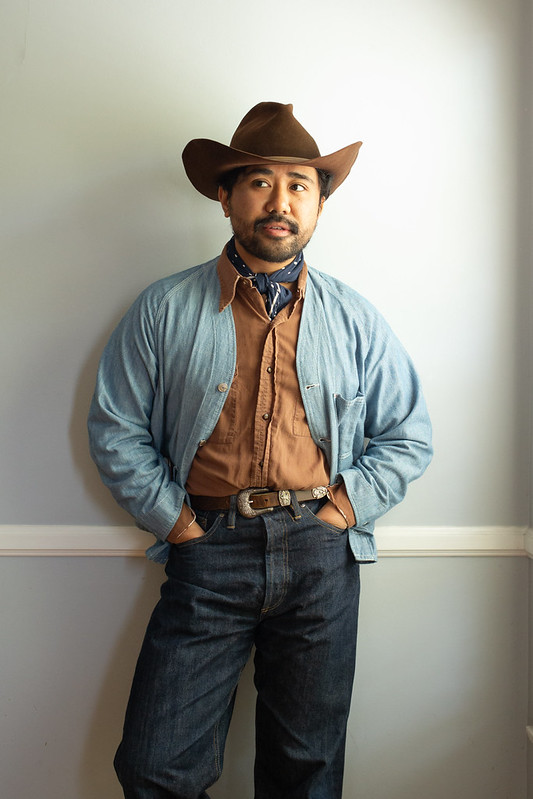
Obviously, I’m not exactly alone in this more “maximalist” idea of Form. MJ and Spencer— as well as newer pals like Ivan and Arthur— all tend to always wear a jacket, shirt, trousers, leather shoes, and some sort of neckwear (or accessory). In fact, a conversation with Ivan was another impetus for this very blog post. In talking about recent outfits, we remarked that we both have a similar Basal Look, particularly through our internally imposed adherence to wearing a jacket and neckwear. This is a big part of our Personal Style, as we know guys who often leave those things at home. Not us. Whether it’s hot or cold, we stick to our Form of what a complete Outfit is.
Of course, after that, the obvious difference between our Styles is that my version leans toward tailoring (sportcoat + necktie), while his incorporates a cropped jacket (workwear or leather) and a bandana. But I believe that those styling decisions first emanate from the core decision of Form. Personal Style is found in the Template we pick and in how we choose to fill it.


I know all of this must sound silly and perhaps recursive, but it really explains so much about how I think about clothes or, more specifically, how I feel about outfits and when something is holistic and a complete vibe. Nothing’s radically changed after I figured out this “truth” about my mindset, but I do think I have a better idea of how to discuss the concept of Personal Style without simply saying “it’s just who you are” or “wear what you like.” If anything, it’s a deeper version of “what or who do you want to look like,” which is a particular focus in exploring how you think about the end goal—and just how you’ll leverage or fill the expressive slots needed to make it feel whole.
In that way, understanding what our elements comprise in your desired Format helps turn a creative inkling into something actionable. Knowing what comprises your Template lays out your expressive path and reveals all the opportunities, or slots, for expression. And whether your template is maximalist or minimal, knowing it will show you exactly what techniques and shorthands to leverage. It even shows you the opportunities for restraint— or where you can afford yourself to go out with wild abandon.
I’d even say that knowing your Template can provide you with a more discerning eye, an astrolabe to navigate you through the elements you encounter as you continue on your fashion journey, like a garment or style trend you haven’t seen before. Each “item” can be evaluated in how it functions with the slots of your Template, making each purchase or cue less random and more intentional, or at least aesthetically pragmatic. You’ll soon find out just how each of these cues harmonize and support each other, all contributing their own special part of the Whole (Form). And so, knowing the elements of your Rubric and how you implement them will help you know which elements to keep with you— and what you leave behind. Personal Style will always be a blend of Taste and Expression, but the trick is knowing how each part manifests, both in the overall Form and in the techniques/actions we take to fill it. There’s something so interesting about recognizing your consistencies!
At the end of the day, understanding the Form and Template of our outfits isn’t merely an exercise in being more intentional with clothing, but an exploration of how we connect with Art and Creativity in general. Getting dressed, composing music, painting– it’s all sides of the same coin. The earlier you figure this out, the easier—or at least, the more fun— the challenge will be. And honestly, fun with a bit of direction is all you could really ask for when you’re creating something. I’d rather focus on that part than on the buying. Again, I haven’t really bought anything new in ages!
Of course, after writing this one, I think I’ve pretty much covered all I can on how I think about putting outfits together. I’m not sure what to really cover next, other than wearing the damn outfits.
Isn’t that the point of this whole thing?
– end of blog –








>


Thanks for listening and reading along! Don’t forget to support us on Patreon to get some extra content and access to our exclusive Discord.
Always a pleasure,
Ethan
Big thank you to our top-tier Patrons (the SaDCast Fanatics): Philip, Shane, Henrik, and Mason.

