This is a blog post that goes along with the most recent bonus pod! You can listen to the first 15 minutes of the bonus pod below, but you’ll have to subscribe on Patreon to get the RSS feed of the full episode (as well as access to our Discord).
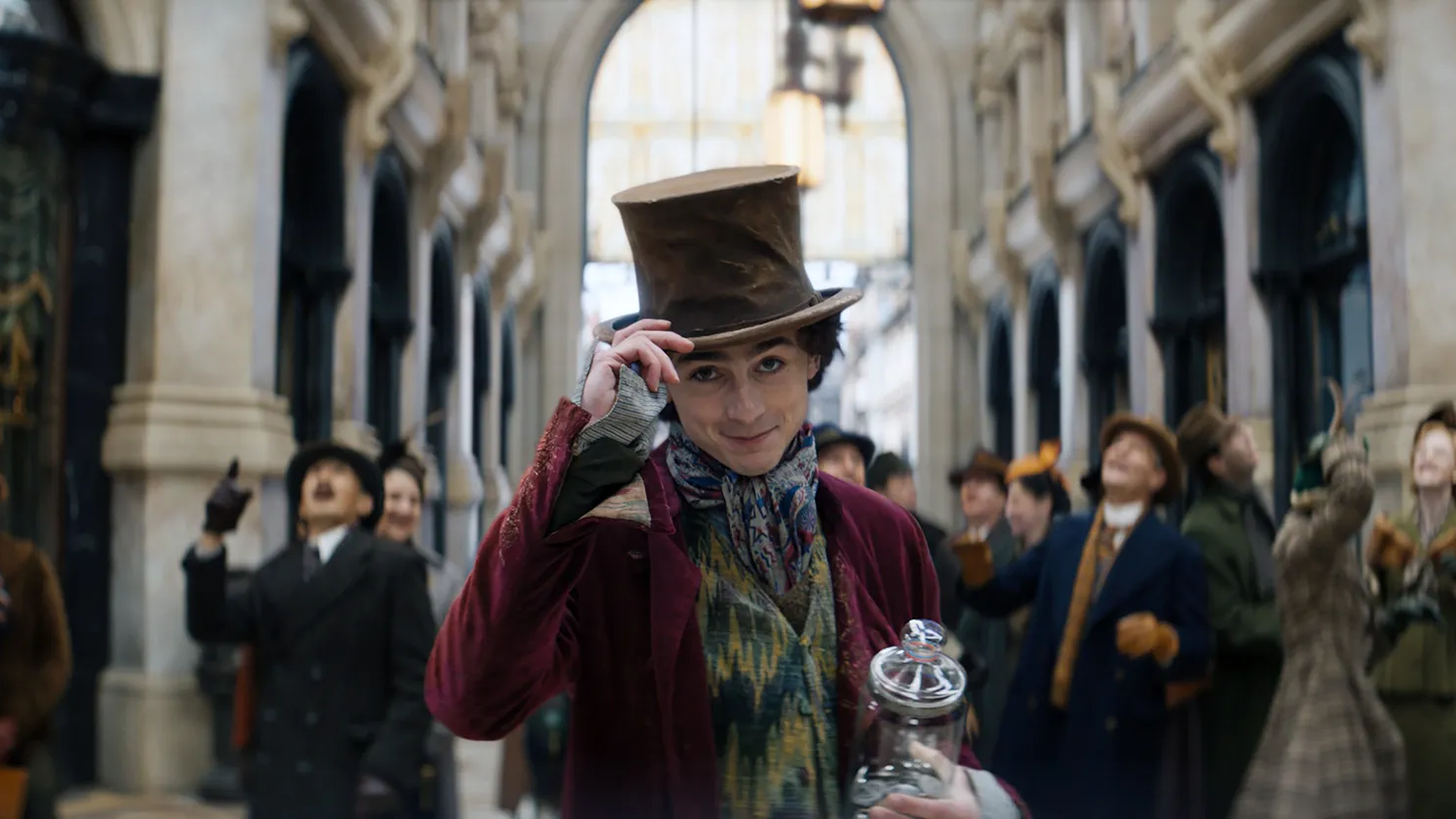
I remember when I first saw the initial photo of Timothée Chalamet playing a young Willy Wonka: a beaten top hat drawn down dramatically, shadows on Chalamet’s angular features, and a particularly whimsical, Victorian-esque outfit, all with Hollywood snow falling all around. It looked hilarious, another try-hard reboot that was completely unnecessary. Who the hell was asking for a Wonka origin story? And then, shortly before the movie was released, I found out that the damn thing was a musical. The infamous artsy and moody Hollywood fuckboi, fresh from his outing as Paul “Muad’Dib” Atreides, was now going to sing and dance while wearing a big velvet coat and a humorously large jaunty scarf. I was now incredibly intrigued.
This was mainly because I grew up as a fan of Charlie & the Chocolate Factory as well as being a voracious eater of all things chocolate (particularly if it had nuts). Back when I was young, “Wonka” bars still existed, and I always dreamed of opening one up to find a Golden Ticket inviting me to tour the factory, and perhaps become an heir to a confectionery empire. It never happened, of course, and the Wonka name was later dropped from stores when the brand was sold to Ferro Rocher (though products like “Nerds” and “Laffy Taffy” still exist, just without the Wonka name). As an adult, I seldom buy chocolate bars, let alone candy in general, as my sugar intake mainly comes in the form of cookies and ice cream (mostly together in the form of “Pizookies”), but I do miss the idea of sweets all wrapped up in a fun, eccentric manner. Being able to relive the joy of candy in the form of Wonka did tickle me a bit. I needed a silly, whimsical little film. And you know what? I enjoyed it!
To be clear, it’s not a perfect film. Hell, it’s even more geared toward kids than either of the previous adaptations of Dahl’s beloved book, being basically a Paddington Bear reskin with a Timothée Chalamet. But that’s what makes it so endearing and ultimately captivating, if you don’t have a problem with abject, wholesome silliness and a whole lotta singing. Young Willy Wonka is portrayed as a perpetually optimistic magician-turned-inventor who loves making chocolate almost as much as he loves making people happy. It’s a little cringe and over the top, but that’s definitely who I imagined Wonka to be when I was a kid, at least compared to the other portrayals. And while a lot of it does indeed reference the 1971 film, this one feels closer to the book’s ideals; a good quality, as I found Gene Wilder’s take a bit too sarcastic and wry for my liking.
Of course, it helped that all of the clothing in Wonka was delightfully vintage. The film doesn’t specify where and when it takes place, but the general aesthetics and styling of the people and town point toward a pre-WWII European nation, feeling like something from a Wes Anderson flick or The Shop Around The Corner (which is indeed set in 30s Budapest). Seeing all of the period-inspired, sartorial fits on everyone from Wonka (who has always been a dandy) to his friendly compatriots and cartoonish antagonists was as much of a treat as the in-universe hover-chocs; I want to fly after eating chocolate!
I definitely remember being quite taken by the clothing all those years ago, but the boys and I ultimately decided to cover Maestro, as it was a more serious film that covered a few decades, making for a more interesting menswear deep dive. But now, a few years later and having finally explored the subject of Whimsy (as well as after fully learning “A World of Your Own” for karaoke), it was only natural that we take the time to cover the colorful and delectable menswear in Wonka.


One of the major reasons I wanted to cover Wonka on the pod was because of, well, Mr. Wonka himself. He’s quite an interesting character to create a costume for, not just due to his inherent quirks and personality (whimsical people have intricate style), but because there is precedent for Wonka’s attire. I can’t recall if we’ve ever covered this type of costuming before, as most of the movies we’ve done weren’t adaptations— outside of Gatsby, of course. But when it comes to Wonka, who comes from a beloved childhood book and was already shown with fun style in two ubiquitous films, we can’t ignore seeing how each of them tackles the challenge of dressing this extraordinary little man.
First, let’s look at how Dahl described Wonka in the books. “Mr. Wonka was standing all alone just inside the open gates of the factory. And what an extraordinary little man he was! He had a black top hat on his head. He wore a tailcoat made of a beautiful plum-coloured velvet. His trousers were bottle green. His gloves were pearly grey. And in one hand, he carried a fine gold-topped walking cane.” It’s clear from the get-go that Dahl intended for Wonka to look like an eccentric, as even in 1964, when the book was first published, all of these pieces are a ways away from typical menswear. No one was wearing velvet tail coats or top hats, not even in Europe.
With this detail, lifting Wonka’s attire to the silver screen seven years later would have been quite easy (much like Gatsby and how much his wardrobe is described in the books), but this is where it gets interesting. Apparently, Gene Wilder, who portrayed Wonka in the 1971 film, had thoughts regarding the costume and penned them to the costume designer Helen Colvig. Wilder wanted pockets on the coat, the top hat to be just a smidge shorter, and beige trousers instead of green. His rationale was that he viewed Wonka as someone with taste, a person who wore unique clothes, rather than a true eccentric who was simply wearing outdated garments. There’s something discerning, more intentional about Wilder’s Wonka.
Colvig apparently took Wilder’s notes to heart, ultimately creating an iconic movie outfit that definitely looks like a 1970s man got inspired by the early 1900s. The look is still dated (I don’t think any movie can be truly timeless), but it’s still plenty fun with a few details to enjoy. I particularly noticed how khaki trousers are slim-straight and taper to a brown heeled boot that matches his hat! This use of browns makes Wilder’s Wonka feel a bit sprightlier (Charlie’s tour takes place in winter) and even a bit preppy; it’s not as wild as the books make him out to be, though it’s plenty bold. There’s also how his purple velvet coat has the fun details of the late 60s and 70s with wide blunted lapels and heavy use of piping; Mad King George would certainly make a killer Wonka suit. In a way, the whole thing feels a bit more sensible while being a bit fashionable (most of the characters are dressed a bit trad or “normal”), which plays ever more into Wilder’s kooky and snarky take on the Dahl character.


In 2006, Tim Burton released his own adaptation of the beloved children’s book, tapping Johnny Depp to play the chocolatier (who based his performance on kid show TV hosts) and Gabriella Pescucci to do the costumes. This version of Wonka is still wacky, but trades Wilder’s deadpan style for pure wackyness and adds in a bit of strange, creating a dark undertone that colors how Wonka carries himself. This odd combination is par for the course in a Burton flick– and so is the use of gothic-inspired style cues in Wonka’s attire.
Depp’s Wonka wears a dramatic, sharply cut frock coat made of striped burgundy velvet, cut on the bias for a diagonal effect. You’ll notice that the coat’s collar stands upright while the lapel lies flat, a detail that, along with the closely spaced buttons, looks more 1800s than 1900s. The antiquarian attitude is then emphasized with an asymmetrical-closure waistcoat, which makes this quirky industrialist look a bit closed up and militaristic (1800s styling tends to have that effect). Wonka also wears a puffy poet shirt in a dark red-and-green paisley melange, with the collar (or matching cravat?) held together by a “W” tie pin. Interestingly, Wonka’s top hat (now black) uses two layers of ribbons: a purplish waffle-textured one lies on top of the standard burgundy band. Add in a plethora of watch chains, slim trousers, and a bob haircut (a proper and certainly effeminate do compared to Wilder’s wild and curly locks), and you end up with a Dickensian take on the kindly inventor, just wrapped up in the gothic flavor that Burton is famous for.
In the end, Wonka stands out even more spectacularly among his contest winners, who, in true Burton fashion, are still decidedly anachronistic: Mike Teevee looks Y2K, but his dad is straight from the 80s, the Beauregards wear 70s velour athletic suits, and the two Buckets seem to dress exclusively in 40s-early 60s menswear.
Out of the two, I think I like Depp’s version more, just because it does feel a bit more dramatic and sartorial. Of course, these are all takes on a grown-up Willy Wonka, when his brand is firmly established, even if the man himself is a bit of an enigma. What attire would this man have worn when he was younger and scrappier? Do you think any of his iconic cues would have shown up back then? Thankfully, we don’t have to wonder too hard, as Timothée Chalamet’s outing as Willy answers it for us.


Chalamet’s Wonka sees him at the very start of his career. “After seven years of life upon the ocean”, the aspiring magician turned chocolatier has finally docked at…an unnamed European port city with a huge food (specifically chocolate) scene. Again, the time period seems to be vaguely pre-WWII (maybe mid-1930s) if the locals’ attire, graphic design, cars, and overall “technology” are anything to go on, but much like a Tim Burton or Wes Anderson film, the exact setting is meant to be vague and unreal. This isn’t real life, but a whimsical and quirky version of it, where chocolate reigns supreme (serving as food and currency), and we have towns full of wholesome bystanders and cartoonishly villainous choco-capitalists. And so, one would think that Wonka’s attire would fit right in, as he’s already a whimsical and quirky person. Perhaps he’s just a regular guy in this version. Nah.
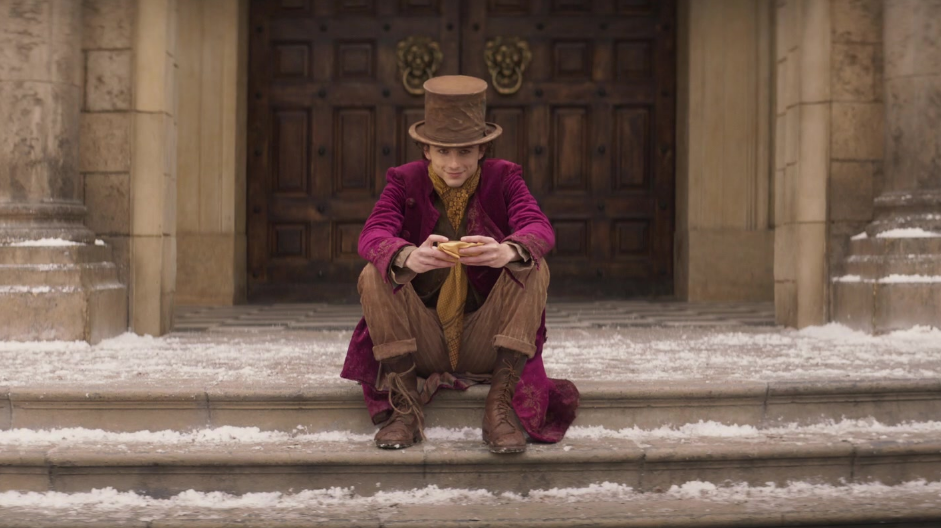
Wonka immediately stands out, even in this already colorful and rather stylish world. Much of that is due to his perpetual optimism (the fact that it’s wholesome rather than arrogant makes Wonka stand in contrast to Chalamet’s typical roles), but it’s also because the young man dresses incredibly boldly, even by vintage standards, as his look is much older. With a long coat, tall hat, and jaunty scarves (almost evoking an old cravat, likely in lieu of a tie), this Wonka looks a bit like he’s a member of the Victorian gentry, leaping out of a Charles Dickens book. The ensemble also calls to mind the trappings of a stereotypical magician (just in various colors rather than white tie), which Wonka does reference in the film; he initially wanted to be a magician, which explains his ease at public demonstration as well as all the zany tricks and inventions he has, quite literally, up his sleeve and in his hat. He does indeed look affluent, but the closer you look, the more you realize that he’s just a struggling artist. Wonka is simply temporarily embarrassed.
Each of his pieces is tattered and torn: buttons have fallen off his shirt and velvet frock coat, his trousers are a bit stained (from chocolate, we hope), and the top hat is wrinkly and has faded from its original black color to a dusty brown. Yes, the ensemble is dandy, but it’s improvised, cobbled together from whatever he can find: the striped tan pants (harkening to the beige slacks worn by Wilder-Wonka) are from a mailman from Minsk, the coat is a velvet frock, complete with beautiful gold embroidery, is likely from his magician days and serves as his only piece of luxury— outside of his collection of vibrant scarves, all tied in different ways throughout the film. Wonka dons various striped band-collar shirts, which he wears under a DB work vest and a silk Victorian vest-jacket (similar to a sport vest), whose abstract green front serves as a nod to the bottle-green trousers mentioned in the book.
In a sense, it may not be that Wonka is a man stuck in the past, but rather someone who only had the past to take clothes from. But I also simply believe that this is the way Wonka chooses to dress. It’s clear that Willy likes being dressed up, not for formality, because it just makes sense for his theatrical personality. Perhaps these are the best garments that fit his life! And even with a rather minimal wardrobe, Mr. Wonka does take care to style himself based on mood and Occasion. This is mainly shown when he finally gets a proper storefront: he fastens his coat (to the top) and affixes one of his scarves into a bow, presenting a more “formal” effect than his typical attire. Overall, Wonka’s style is truly incredible and expressive, both in-universe and in the meta: Mr. Wonka is fantastical and truly unreal—much like his chocolates.
I find the whole thing rather endearing. After all, I do find kinship with Willy, not just with having a strong sense of POV and Whimsy (Wonka clearly doesn’t want to just wear a normal suit), but with the idea of using what you have around you to create the look you want. I’ve certainly done that myself; while some of my suits have moved to being custom, a lot of my shirts and trousers are thrifted! Add in young Wonka’s penchant for show tunes, and I’m literally him (a phrase I’ve used before when covering Mr. Chalemet’s characters).
If this film is truly meant to be a prequel to the 1971 film, then we can treat this as a bit of foreshadowing, where Chalamet-Wonka is thrifting items that he (Wilder-Wonka) would later get custom-made thirty or so years later. He even matches his hat to his boots! At the very least, Chalamet-Wonka’s attire is a “reinterpretation of the familiar”, according to costume designer Lindy Hemming. Wonka’s overall look has certainly been codified, and it’s fun to see a new take, especially one that goes into his past.


Even though young Willy Wonka is indeed quite the macaroni, he’s far from the only well-dressed person in the prequel film. Much like a Wes Anderson flick or even Tintin, everyone is styled in expressive, sophisticated vintage outfits. Even all of the extras look great, as they can be seen in fedoras, suits, striped spearpoint shirts, big overcoats (some belted, some Mackinaws), and in one particular case, an inverness cape. Modern outfits could never!
It’s funny; whenever a piece of media wants to be quirky and whimsical but still feel familiar, vintage or period-inspired styling is often the way to go. This makes sense, as such outfits tend to incorporate numerous details and layers, allowing you to play with nuances in how you express a character’s personality or backstory. In other words, vintage just gives you more to work with! It makes each outfit seen in Wonka a visual treat for sartorial and vintage-minded enthusiasts. There’s so much to enjoy, especially from the supporting cast.
Abacus Crunch, the loveably grumpy accountant, wears a dreary plaid suit, but his use of a cozy light blue cable knit cardigan hints at his soft, grandpa side (half-moon glasses certainly help here). When Wonka opens his store, Crunch has an all-pink ensemble, trading his cardigan for workwear vest made from a pink dobby stripe canvas; I love it when casual or sporty things get put through a dandy lens. The comedian Larry Chucklesworth can be seen in a red plaid tweed jacket (harkening to 70s stand-up comics) as well as a two-tone bowling shirt, both making him look like quite the casual American. The dastardly Mr. Bleacher, who co-owns the laundrette with the equally nasty Mrs. Scrubbit, has a bit of an Alpine flair, wearing a plaid workshirt and checked tie under a corduroy waistcoat and knee-length DB leather coat; his Bavarian appearance comes full circle when he dons short lederhosen to seduce his business partner.
To give the Oompa Loompas some much-needed dignity (the original book’s characterizations are quite problematic, to say the least), Wonka reimagines the choco-obsessed people as a very distinguished group, which is best represented by the proud Lofty, played by Hugh Grant. Lofty, shown as being basically an English gentleman just with orange skin, coiffed green hair, and short stature, is quite literally the epitome of class, wearing, at all times, an ascot, a harmonized pocket square, and a pair of plus-fours. This guardian of the cacao bean even gets to wear a yacht cap and a straw boater! Lofty’s jackets do change depending on the “Occasion”: he wears two different regatta blazers, but is first seen in a purplish-plaid plus-fours suit, which, yes, also has quad pleated-patch pockets. He may be a dandy, but Lofty at least knows how to be sporty, or dare I say jaunty.

Of course, I would be remiss if I didn’t finish this blog off by talking about the Chocolate Cartel, the trio of villains who are some of the most sartorially inclined characters I’ve ever seen in recent films. Seriously, these guys are dressed up!
At director Paul King’s insistence, each of the Chocolatiers was assigned a specific color, one that would be present across their wares and branding: Fickelgruber was green, Prodnose got yellow, and Slugworth a commanding navy blue. It would have been easy to put them in generic suits that happen to be color coordinated, but Hemming decided to go the extra mile and make each suit (and their accouterments) quite distinct and full of fun details, much to the enjoyment of this vintage-sartorial enthusiast.
Fickelgruber’s green suit is single-breasted with peak lapels, cut the 30s way with a structured shoulder, nipped waist, and a slightly bellied lapel. He makes use of a waistcoat, both to match the suit (using SB and DB variations) as well as a jacquard odd vest. Slugworth, as the de facto leader of the Cartel, goes full Phoenician Scheme with a navy pinstripe DB which, like Fickelgruber, can also include a matching waistcoat. However, my favorite has to be Prodnose, who wears a striking yellow plaid 6×3 DB which, despite its “trussed up” attitude, also includes triple pleated patch pockets, giving the whole thing a rather 1910s-20s attitude. I guess when you have someone else already in a DB, you need to do something to make it different, and that’s where the rich history of tailored menswear comes in!
Their attire gets even better when you notice that they each have multiple suits, at least in the case of Prodnose and Slugworth. It’s apparent when you look at their suit patterns: the pinstripes and plaids actually vary between scenes , showing that these conniving gentlemen have a full wardrobe of similar but distinct pieces. Perhaps I have something in common with these Chocolatiers as well (their sultry villain song is quite catchy).
According to Die, Workwear, Hemming apparently tapped a few bespoke firms to create these delectable garments, one of which was Fred Niddeu of Taillour, who is no stranger to crafting period cuts for all things Entertainment (The Crown, The Phoenician Scheme). Each suit is cut nicely and full (with a cuff on the trouser hem), further emphasizing the vintage aesthetic of the film.
The villainous trio is unified not just by their use of peak lapels, but also by their contrast collar shirts, an old-school business-attire move that makes them look particularly dandy and rather formal compared to the quirky Wonka (who has no shirt collar at all). I was delighted to see that Prodnose, in particular, employs a stiff, detachable club collar, another fun nod to 1910s/20s sartorial style; he and Slugworth both have their shirt bodies match their suits. In the case of Fickelgruber, he opts instead to use blue or pink stripes on his shirt base, which provides a nice contrast (this is a move I make whenever I wear my own green suit).
As for neckwear, Slugworth and Fickelgruber alternate between various foulards and stripes, with a different choice in each scene; the former sticks with navy, while the latter uses both green and purplish-pink (which is also echoed in his pocket square choice). Prodnose is the only one in a bowtie, which is as yellow/gold (and plaid) as his suits. Each of these gentlemen gets a matching overcoat and a hat: Fickelgruber has a big green fedora, Slugworth has a black homburg, and Prodnose has a brown derby.
Again, only vintage styling allows a costumer the ability to have so much fun with the details of a menswear outfit, all while still feeling largely familiar and accessible to viewers!

As I’ve written about before, it seems that musicals remain an untapped market for fit inspo. I just wasn’t expecting it to take the form of an unnecessary but overall, delightful and wholesome prequel/reboot about a quirky chocolate-inventor. Lindy Hemming and her team certainly did an amazing job in dressing this film, not just with Wonka but with quite literally every character on screen! This is the kind of attention to detail that we love to see, especially in a more positive film than something too dramatic or tense.
Obviously, not every film needs to be dressed this way, nor be as wonderfully saccharine, but Wonka serves as a great palette cleanser. Its colorful clothing and charming musical numbers provide a respite against the dire real world, proving to us that kindness is always the best way forward, chocolate is indeed amazing, and that things can just be fun for fun’s sake. Oh, and breaking out in song and dance (while wearing vintage clothes) is always a great choice!
Perhaps my enjoyment of the menswear in this film is truly a sign that I’ve simply gotten exponentially more dandy over the years. After all, I do own both a navy pinstripe and a green suit. I’m just missing Prodnose’s yellow plaid number (I’d likely do brown and in a 6×2), Lofty’s boating blazer, and perhaps a red (or purple) velvet coat. I don’t think I need a top hat, but we’ll see. Never say never, right?
[PS: I suggest you read this and this if you want to hear more about how Lindy Hemming approached the costumes for this film!)
– end of blog post –


Thanks for listening and reading along! Don’t forget to support us on Patreon to get some extra content and access to our exclusive Discord.
The Podcast is produced by MJ.
Always a pleasure,
Ethan
Big thank you to our top-tier Patrons (the SaDCast Fanatics), Philip, Shane, Henrik, and Mason.


One comment